

Most business owners we speak to here in Perth aren’t struggling because they’re bad at what they do. They’re struggling because the work doesn’t find them, and the marketing advice out there is either generic, contradictory, or written by someone who’s never actually run a local business.
Here’s the thing nobody talks about: lead generation in Perth doesn’t work the same way it does in Sydney or Melbourne. The market’s smaller, the suburbs behave differently, the mining cycle still ripples through discretionary spending, and the strategies that work for an east coast operator aren’t always the right call here. So this guide is the honest, Perth-specific version. We’ll walk through every realistic way to generate leads in 2026, what it actually costs, what works for which type of business, and which channels we’d tell our own mates to avoid completely.
Quick note for context: we run a lead generation business here in Perth. So yes, we have a horse in this race. But you’ll notice we tell you when DIY beats hiring someone like us, because the worst thing we could do for our reputation is sell something to a business that doesn’t need it.
Why Most Perth Businesses Struggle to Get Consistent Leads
Here’s the thing nobody tells you when you start out here: being good at your trade or service is maybe 30% of the equation. The other 70% is making sure the right people know you exist, choose you over competitors, and contact you before they get distracted.
That’s marketing. And most owners we meet are either avoiding it, dabbling in it, or paying someone too much to do it badly.
The Perth market has quirks that genuinely change the playbook. It’s smaller than Sydney or Melbourne, which means less competition for visibility but also a smaller pool of customers, so wasted marketing spend stings harder here. Networks overlap heavily, so reputation spreads fast in both directions. The mining cycle still affects discretionary spending in waves that east coast operators don’t have to think about. And homeowners in suburbs like Cottesloe behave very differently from those in Mandurah or Ellenbrook, even when they’re searching for the same service. A campaign tuned for Sydney’s CBD-and-suburbs sprawl falls flat in a city where geography, demographics, and seasonal work patterns all skew differently.
What’s changed in the last decade is how people find you. The vast majority of customers now Google before they call. They check reviews, compare three or four options, and make a decision before they ever pick up the phone. If you’re not visible during that process, you’re invisible to most of the market, even the customers who would have loved your work.
So what actually works in Perth specifically? Here’s every realistic option, ranked honestly.
Word of Mouth and Referrals (Where Most Local Businesses Start)
Word of mouth is still the strongest form of marketing. A recommendation from a mate carries more weight than any ad you’ll ever run. And in a city this size, where networks overlap more than people realise, a good reputation travels.
The problem? You can’t control it. You can’t dial it up when work is slow. You can’t ask it to send you the high-margin jobs and skip the tyre-kickers. It’s a passive system, and passive systems don’t pay the bills when the calendar’s empty.
The fix isn’t to abandon word of mouth, it’s to systemise it. After every completed job, ask the customer directly: “If you know anyone else who needs [service], I’d really appreciate the referral.” Most people are happy to. They just need the prompt. You can take it further by offering a small incentive, a $50 gift card or a discount on their next service. The cost is nothing compared to a new customer’s lifetime value.
Build referral partnerships with complementary local businesses too. If you’re a sparky, link up with a local electrician supplier or a local builder. If you’re a concreter, get to know the landscapers and pool builders working the same suburbs. These partnerships compound over time.
Best for: Established businesses with a happy customer base. Solo operators in tight-knit suburbs. Worst for: Anyone trying to grow predictably or scale beyond word of mouth’s natural ceiling.
BNI, Chamber of Commerce and Local Networking (Reality Check)
This is the advice you’ll see on Reddit and from older business owners: join BNI, get to Perth Chamber of Commerce events, show up consistently, and the leads will come.
It’s not bad advice. It’s incomplete advice.
BNI works for some operators here. It costs around $1,500+ a year, requires you to attend weekly 7am meetings, and the model is built around members exclusively referring work to each other. If your business is the kind where one good client is worth $10,000+ in lifetime value, say, a financial planner, a renovation builder, or a commercial cleaning company, the maths can work. You can win a few jobs a year and clear the membership cost easily.
If you’re a sole-operator tradie doing $500 jobs, the maths is harder. You need a lot of small jobs to justify weeks of 7am starts. Many tradies join BNI, put in months of effort, and quietly stop attending when the leads don’t materialise at the volume they expected.
The Perth Chamber of Commerce and local industry networking events have a similar profile. They’re brilliant for relationship-building if you’ve got a B2B-leaning service or you’re trying to land bigger commercial contracts. They’re less useful if your customer is a homeowner in Baldivis who’s never going to attend a chamber event.
The honest take: networking is one part of a broader strategy, not a primary lead source for most local businesses. Treat it as a long-term reputation play, not a tap you can turn on this week.
Best for: B2B services, high-ticket trades, anyone selling to business decision-makers. Worst for: Most residential tradies and home services where the customer isn’t in the room.
Google Business Profile (The Highest-ROI Free Tool in Perth)
If you only do one thing on this list, do this.
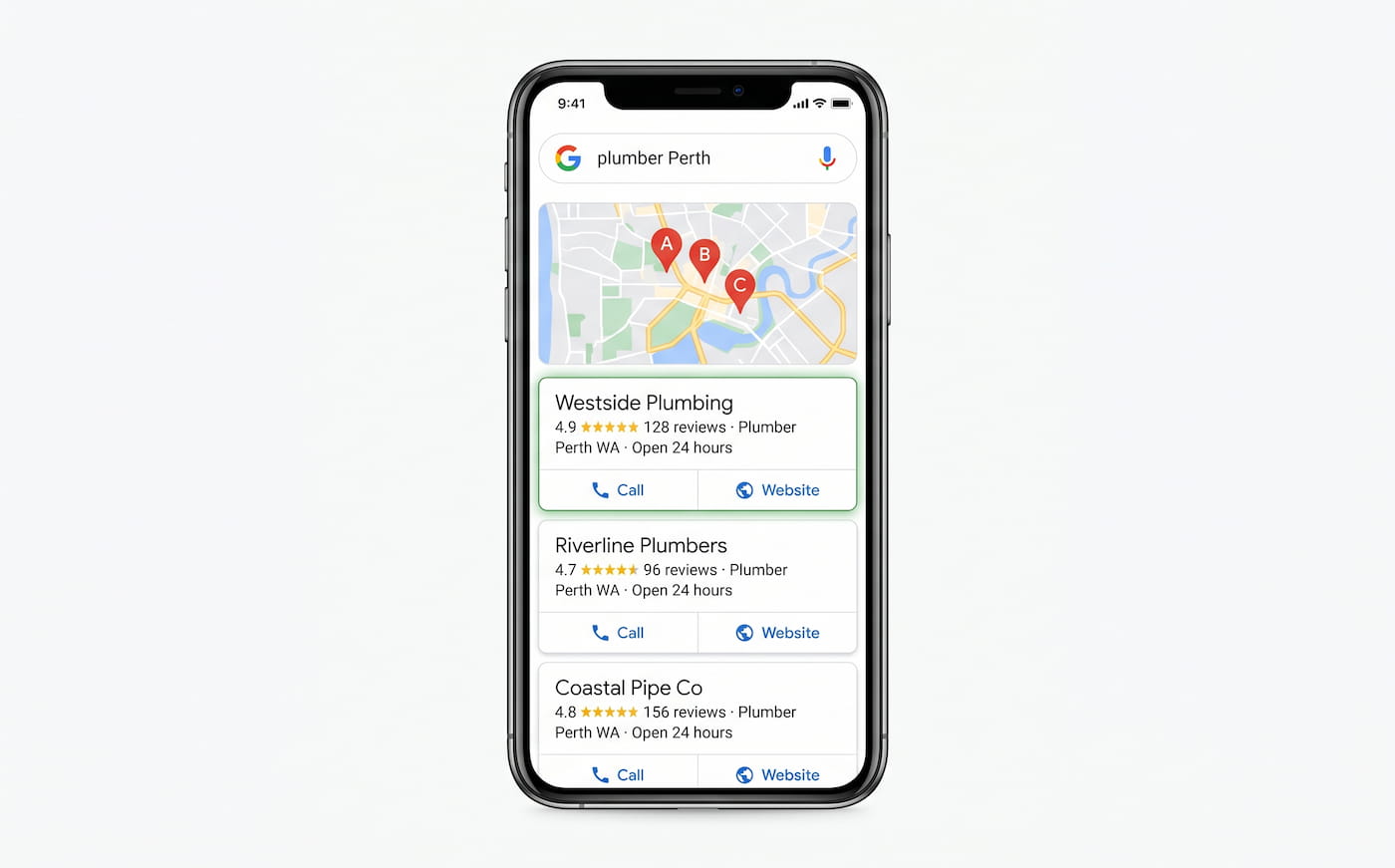
Your Google Business Profile (GBP) is the single most powerful free marketing tool you’ve got. When someone in Subiaco searches “plumber near me” or someone in Mount Lawley searches “electrician Mount Lawley”, the top three results they see are almost always GBP listings, not websites. Those three listings get most of the calls. Everything below them fights for scraps.
Setting up a GBP takes about 20 minutes. Optimising it properly takes more effort, but the payoff is enormous and the cost is zero.
To get the most out of your profile:
- Complete every section, services, suburbs covered, hours, phone, website
- Add real photos of your work, your van, your team. Google rewards regularly updated profiles.
- List every service you offer as a separate service item, not buried in a description
- Post updates regularly, even a photo from a Fremantle job site with a one-line description counts
- Ask every happy customer for a review, in person, with a direct review link sent within 24 hours
That last point is where most local operators leave money on the table. A business with 50 recent reviews at 4.8 stars will outperform a business with five reviews at 5.0 stars every single time. Google’s algorithm cares about volume, recency, and consistency. A review from last week is worth more than ten reviews from 2022.
Not sure if your profile is performing the way it should? Read our guide on how to audit your Google Business Profile to find and fix the issues holding you back. If you’re starting from scratch and want to understand the deeper trust signals Google looks for, our piece on why Google doesn’t trust your business walks through the foundations.
Best for: Any business with a local customer base. Genuinely no exceptions. Worst for: Pure online businesses with no local service area.
Local SEO and Your Website
SEO sounds intimidating, but for a local operator it boils down to one thing: showing up when locals search for what you do.
Someone in Joondalup searching “roof restoration Joondalup” should find you if that’s your service and your area. The way you achieve that is by building dedicated pages on your website for each service-plus-suburb combination that matters to your business.
If you’re a painter covering multiple Perth suburbs, you want pages targeting “painter Mandurah”, “painter Rockingham”, “painter Baldivis” and so on. Each page needs unique content that genuinely speaks to that area, not the same template with the suburb name swapped out. Google has been penalising lazy duplicate content for years, and it’s only getting better at spotting it.
Pair that with a fast, mobile-friendly website, proper heading structure, and a steady flow of new Google reviews, and you’ve got the foundation of a local SEO strategy that compounds. Unlike ads, organic rankings don’t stop working the moment you stop paying.
The realistic timeline here: four to six months to start seeing meaningful organic traffic. That sounds slow, but Perth is genuinely less competitive than Sydney or Melbourne for most service-area keywords, so results come faster here than they would on the east coast. The businesses that win are the ones who start now and let the rankings build over six to twelve months while the competition keeps doing nothing.
Best for: Long-term thinkers who want compound returns. Service businesses covering specific Perth suburbs. Worst for: Businesses needing leads this week. Owners with no patience for compound growth.
Google Ads (When They Make Sense, When They Burn Money)
Google Ads can be a goldmine or a complete money pit. The difference is targeting and intent.
Someone searching “emergency plumber Perth” at 9pm on a Tuesday is not browsing. They need someone right now. If your ad shows up, that’s as warm a lead as you’ll ever get. Someone searching “plumber Perth” with no urgency is far less valuable, and the click costs the same.
A few principles to keep your ad spend productive:
- Start small. $20 to $50 a day is enough to test whether a campaign works before committing real budget
- Target specific services and suburbs, not broad terms. “Blocked drain Fremantle” delivers better leads than “plumber Perth”
- Use call-only ads or call extensions so people can ring you straight from the search results
- Run ads only during the hours you can answer the phone. Paying for clicks at 2am that result in voicemails returned at 9am is throwing money away
- Track everything. If you don’t know your cost per lead, you can’t know whether ads are working. Set up conversion tracking from day one
Cost-per-click for trade services in Perth varies wildly. Emergency services like plumbing or locksmiths can run $15 to $25 per click. Less urgent services like fencing or concreting are usually $3 to $10. Highly competitive niches like personal injury law are an entirely different conversation.
The smartest play we see locally is running Google Ads as a gap-filler while organic rankings build. Run ads in months one through six to generate immediate leads, then scale ad spend back as your GBP and SEO start doing the heavy lifting.
Best for: Filling immediate gaps. Businesses with strong follow-up systems. Services with clear search intent. Worst for: Set-and-forget owners. Businesses with poor websites or slow phone response.
Facebook and Meta Ads
Facebook and Instagram ads work brilliantly for some businesses and waste money for others. The difference comes down to whether your customer is actively searching for you, or whether they need to see you to remember they want what you sell.
Visual trades work well on Facebook. Landscapers showing before-and-after garden transformations. Renovation builders showing kitchen reveals. Pool builders showing finished installs in suburbs like Duncraig or Kingsley. The platform is built for scrolling, and visual results stop the scroll.
Facebook also still has strong reach with Perth homeowners aged 35 to 65, particularly in family-heavy suburbs. If you sell something where the homeowner needs a nudge, a kitchen reno they’ve been putting off, a fence they know needs replacing, Facebook can plant that seed.
Where Facebook ads fail is for emergency or urgent services. Nobody scrolls Instagram looking for a blocked drain plumber. They Google. So if your service is reactive (people only call when something breaks), spend your money on Google Ads and GBP, not Facebook.
The other use case where Facebook earns its keep is offers. A “$99 health check” or “free quote this month” works well as a paid social ad because it gives the scroll-stopper a clear reason to act now.
Best for: Visual trades, planned-purchase services, businesses with a strong offer. Worst for: Emergency services, B2B, anyone without strong creative assets to use in ads.
HiPages, Oneflare, ServiceSeeking and Airtasker (The Honest Truth)
This is the section most tradies skim straight to, so let’s not bury the lead.
Shared lead platforms have a place. They’re easy to start, the upfront commitment is low, and they can fill genuine gaps when your phone isn’t ringing. But the model is structurally stacked against you, and the longer you stay on it, the worse the maths gets.
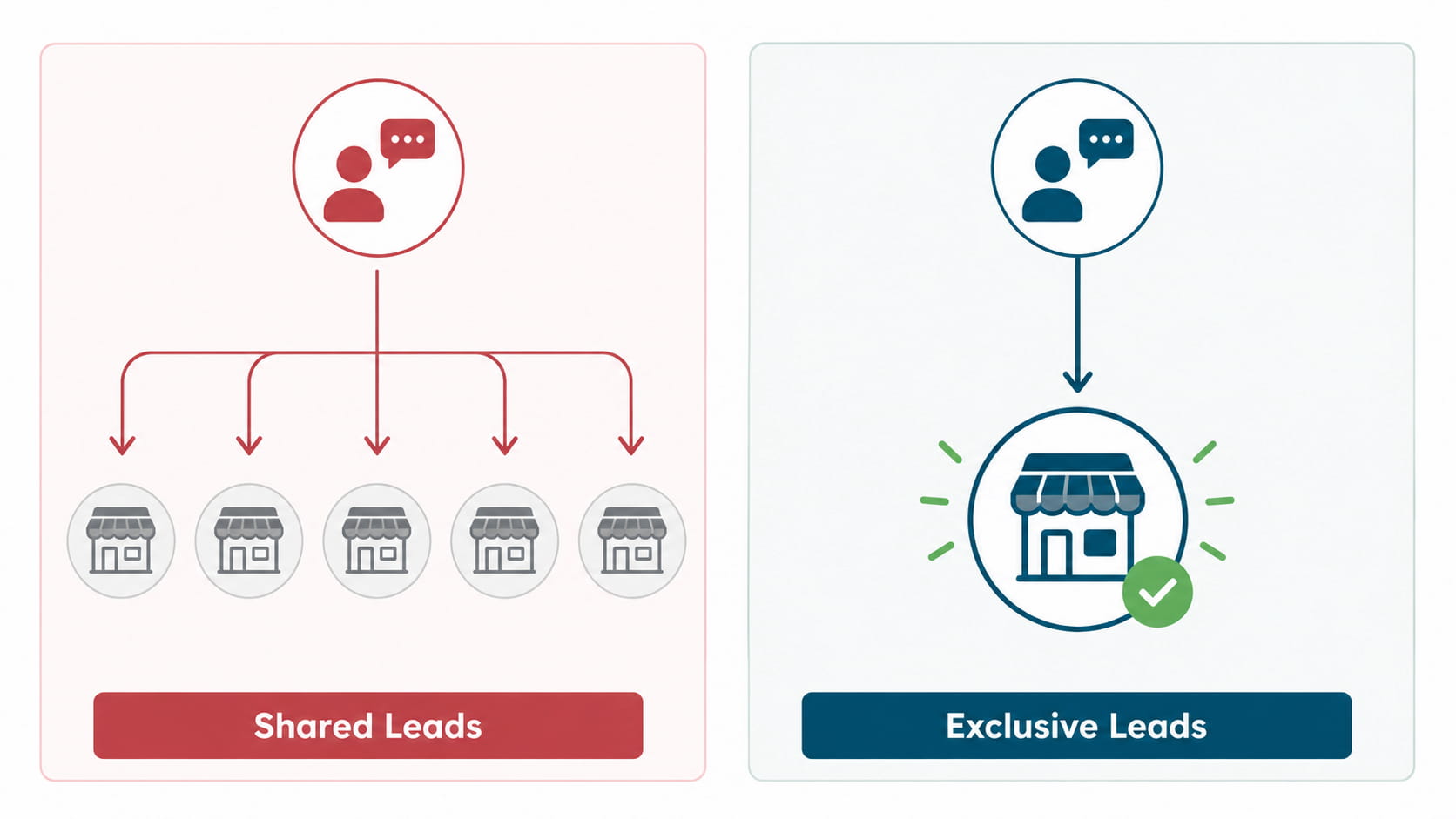
Here’s how it works: you pay for a lead, and that same lead gets sent to three, four, sometimes five other businesses at the same time. You’re competing on price before you’ve even had a conversation. The customer is fielding multiple quotes and choosing whoever’s cheapest, fastest, or first to respond. If you don’t win, you’ve still paid for the lead.
The maths breaks down fast. If you pay $40 per lead and convert one in five, your true cost per booked job is $200, and you’ve burned hours quoting the four you didn’t win. That’s before you account for the price pressure that pulls your margins down on the jobs you do close.
Exclusive leads change the dynamic completely. When you’re the only business who got the enquiry, there’s no race to the bottom on price. The customer called you because they found you, not because a platform sent your details out to four strangers. Your close rate goes up, your cost per job comes down, and you stop wasting time competing on platforms that don’t have your interests at heart.
For a deeper dive into the strategies that work alongside (or instead of) shared lead platforms, our pillar guide on lead generation strategies for tradies covers the alternatives in detail.
Best for: Genuine short-term gap filling when your other channels aren’t working yet. Worst for: A long-term lead strategy. The model gets worse, not better, the longer you rely on it.
Hiring a Lead Generation Agency (What to Actually Look For)
Full disclosure before we get into this: this is what we do at The Lead Gen Lab. So we’ll write this section the way we’d advise a mate evaluating any agency, including us.
First, a clarification that matters more than most people realise. “Lead generation agency” gets used to describe two very different things:
- Generalist digital marketing agencies who include “lead generation” as one service among many. They’ll sell you SEO, content marketing, paid ads, social media management, and call it a lead gen package. The work might generate leads eventually. It might not.
- Specialist lead generation providers who build dedicated systems designed for one purpose: producing exclusive enquiries for your trade in your service area. Everything else, the website, the SEO, the rankings, exists in service of that single outcome.
The difference isn’t semantic. It’s the difference between paying for marketing activity and paying for marketing outcomes. We sit firmly in the second camp, and we’d argue any agency calling itself a “lead generation” specialist should too.
There are three main commercial models you’ll encounter when hiring help:
- Pay-per-lead: You only pay for actual enquiries delivered. Lower risk for you, but the agency needs strong systems to make it profitable for them. Best when you want pure performance accountability.
- Monthly retainer: Fixed fee for the agency to run a dedicated lead generation system on your behalf. Done well, this means a system that’s purpose-built to attract local enquiries for your specific service area, with the agency handling everything from build to optimisation. Done badly, it’s a generic marketing retainer dressed up with a “lead gen” label. Make sure you understand which one you’re buying.
- Commission share: The agency takes a percentage of revenue from leads they generate. Aligns incentives well, but requires deep trust and clear tracking.
If you want to dig deeper into the difference between hiring a generalist marketing agency versus a specialist lead generation provider, we wrote a separate piece on lead generation vs marketing agencies that breaks down which model suits which business.
Red flags to watch for when evaluating any agency:
- Lock-in contracts longer than three months
- No transparency on lead sources or methods
- Generic templates with the suburb name swapped (look at their other client sites)
- Refusal to show you real results from existing clients
- Promises of “first page in 30 days”, legitimate SEO doesn’t work that fast
- Bundling lead generation in with five other services they’re selling you
Green flags to look for:
- Clear explanation of where leads come from and how they’re delivered
- Exclusive leads, not shared
- A dedicated lead generation system built for your trade and area, not a recycled template
- Local team you can actually meet or speak to
- Willingness to do a trial period before locking you in
- Real, named case studies you can verify
One practical test: ask any agency to show you their own Google rankings for relevant Perth terms. If their own SEO is weak, walk away. They can’t do for you what they can’t do for themselves. As a real-world example of what genuine lead generation results look like, our case study on WA Pro Fencing & Gates shows how Nathan added $120K+ in revenue in three months with exclusive leads.
Best for: Businesses generating $500K+ annually who want to scale without becoming part-time marketers. Worst for: Owners who haven’t nailed the basics yet (GBP, website, response time). Fix those first, then talk to an agency.
What Actually Works for Most Local Businesses
Not every strategy on this list will suit every business. A sole-operator sparky in Mandurah has different needs from a 10-person renovation crew in South Perth. The right approach depends on your stage, your margins, and your appetite for marketing work.
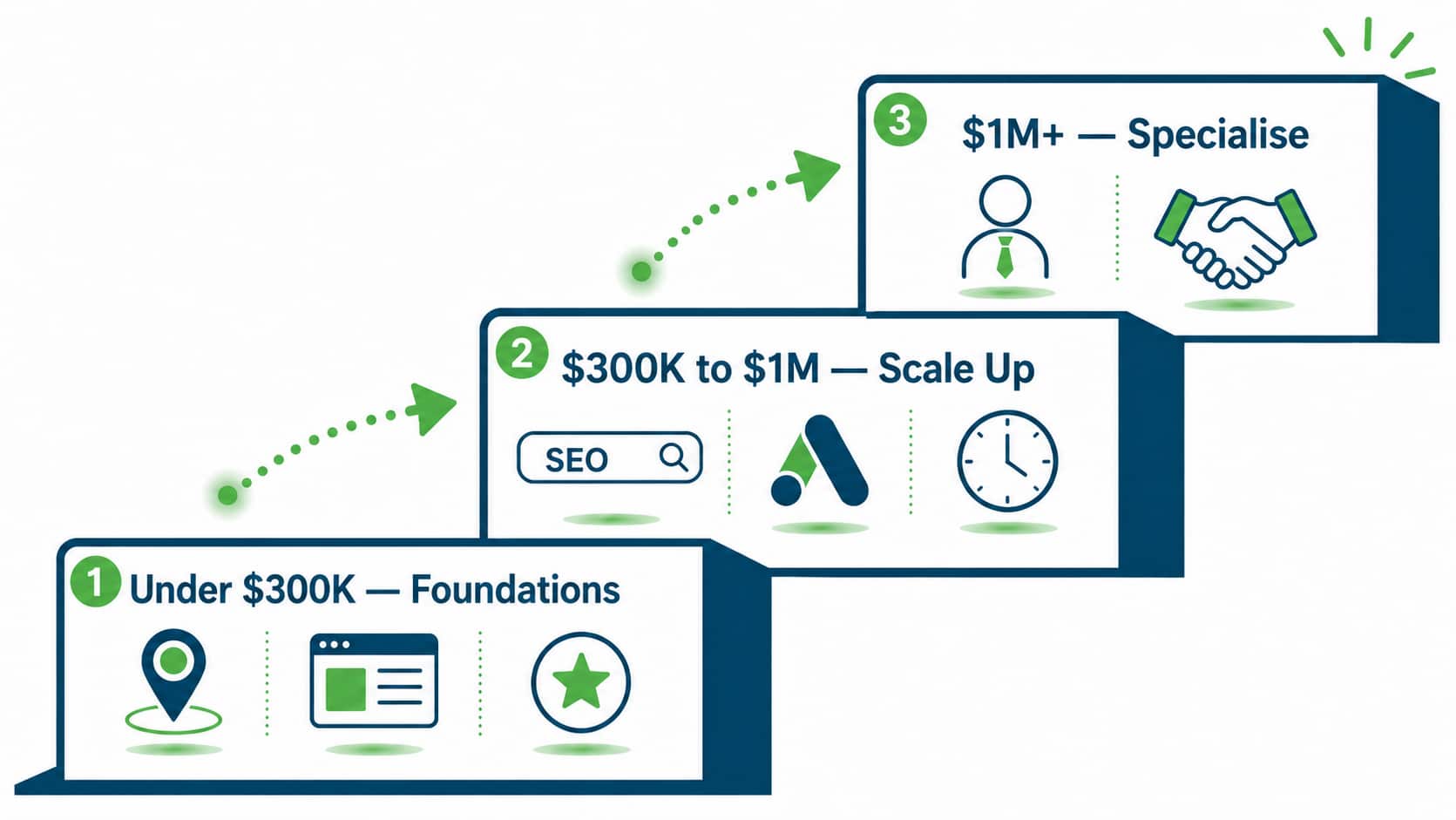
If you’re starting from scratch or rebuilding, here’s the priority order we’d recommend:
- 1Stage 1 (under $300K turnover): Optimise your Google Business Profile. Build a simple, conversion-focused website. Set up a referral system. Get serious about asking every customer for a review. Total cost: minimal. Total impact: massive if you actually do it.
- 2Stage 2 ($300K to $1M): Add local SEO content for your key service-suburb combinations. Run small, well-targeted Google Ads campaigns. Fix your follow-up speed (most businesses lose deals to slow response, not bad service).
- 3Stage 3 ($1M+): Consider hiring a specialist, either an in-house marketer or a lead generation agency. At this stage, the cost of doing marketing badly yourself is higher than the cost of paying someone who knows what they’re doing.
The businesses that win long-term here are the ones who pick two or three channels, execute them well, and measure what’s working. The ones who lose are the ones who chase whatever marketing trend is loudest this month.
What Reddit Gets Right (And Wrong) About Lead Generation in Perth
If you found this article from a Reddit thread asking how local businesses get leads, the top answer probably told you to join BNI, get along to chamber of commerce events, and show up consistently. Here’s what’s worth adding to that.
What Reddit got right: relationships matter. Perth is a smaller city than Sydney or Melbourne, and reputation travels fast in both directions. Showing up consistently in your community is real and valuable advice.
What Reddit missed: the entire customer journey has changed. Twenty years ago, networking and word of mouth were enough because there were no other channels. Today, the vast majority of customers Google before they call. Relying purely on networking means being invisible to the 80%+ of your potential market who’ll never attend a BNI breakfast or a chamber event.
The advice isn’t wrong. It’s just incomplete. The real answer is: do the networking, AND optimise your Google Business Profile, AND build local SEO, AND make sure people who Google you find a website that actually converts. Pick the channels that fit your business and your stage, but don’t pretend it’s still 2005.
Frequently Asked Questions
How much does lead generation cost for a small business in Perth?
It varies hugely depending on your channel and stage. Optimising your Google Business Profile is free. Google Ads typically start at $20 to $50 per day for testing. SEO content and website work can range from $1,500 to $10,000+ depending on scope. Lead generation agencies in Perth typically work on $500 to $3,000+ monthly retainers, pay-per-lead pricing, or commission models. Use our lead value calculator to work out what a lead is actually worth to your business before deciding what to spend.
How long does it take to start getting leads from SEO in Perth?
Realistically, four to six months for meaningful results. Perth is less competitive than Sydney or Melbourne for most service-area keywords, so you can see traction faster here than on the east coast. Don’t trust anyone promising first-page rankings in 30 days, that’s not how organic search works.
Are HiPages leads worth it for businesses in Perth?
As a short-term gap filler, sometimes. As a long-term strategy, no. The shared lead model means you’re competing on price with three or four other businesses for every enquiry, which destroys your margins and wastes your quoting time. Use them sparingly while you build channels you actually own.
What’s the best lead generation method for tradies in Perth?
For most local tradies, the highest-ROI starting point is a fully optimised Google Business Profile combined with consistent review generation. Once that’s working, layer in local SEO for your service area and Google Ads for immediate gap-filling. Our full guide on lead generation strategies for tradies covers this in depth.
Should I use a Perth-based agency or a national one?
For local lead generation, Perth-based usually wins. They understand suburb-level dynamics, local competition, and Perth-specific search behaviour. National agencies can be excellent but often treat Perth as an afterthought to their Sydney and Melbourne client base.
How do I know if my Google Business Profile is set up correctly?
The fastest way is to run a structured audit. Our guide on how to audit your Google Business Profile walks through the exact checks that matter, including the trust signals Google uses to decide whether to show you in local search results.
How much should I spend on Google Ads as a small business in Perth?
Start at $20 to $50 per day to test. Don’t increase until you have conversion tracking confirming what a lead actually costs you and what it’s worth. Most local businesses find their sweet spot between $500 and $3,000 per month, but it depends entirely on your service, margins, and competition.
Ready to Stop Guessing About Leads?
Everything in this article is doable yourself. None of it is rocket science, and plenty of operators here build great lead generation systems without ever hiring an agency. If you’ve got the time and patience, this guide is your roadmap.
If you’d rather have someone else handle it, and you want exclusive leads sent only to your business, not shared with three competitors, that’s what we do at The Lead Gen Lab. We build lead generation systems that rank in Google for your trade and your area, generate the enquiries, and send them to one tradie only through our Lead Launch Program.
No lock-in contracts. No shared leads. No competing on price against four other operators who got the same notification you did.
If that sounds like the kind of system you’re after, get in touch and we’ll show you how it works for your specific business.
Ready For More Quality Leads?
Apply for the Lead Launch Program and start getting exclusive, high-intent enquiries sent straight to you, with no shared leads and no bidding wars.