

Can you use AI-generated content on your website without Google turning on you? Yes, as long as a person checks every word before it goes live. On 1 October 2026 Google updated its guidance on generative AI content to say so in plain terms: AI tools predict words rather than look up facts, so you have to fact-check and review everything they write, right down to your page titles and image alt text.
I'm Jacob Frecklington, co-founder of The Lead Gen Lab. Levi and I went through Google's updated page, its spam policies and the rater guidelines line by line, because nearly every trade business we talk to is now using ChatGPT or something like it to write web pages. Here's what changed, what Google actually says about AI content, and how to use AI for SEO without putting your site at risk.
What Changed In Google's AI Content Guidance On 1 October
Google's Search Central changelog lists the change on 1 October 2026 as an update to its guide on using generative AI content, "to get our documentation in sync with our presentations we use at our developer events". We compared the current page with an archived copy from 27 September 2026. One paragraph is new, and it's the one that matters:
Keep in mind that generative models don't retrieve facts, but predict a likely sequence of words based on their training data. Because of this, generative AI outputs may contain inaccuracies (also known as hallucinations). It is critical to manually factcheck and review all AI-generated content for accuracy and trustworthiness before publishing.
The same section already told site owners to check metadata. It now reads as part of that review: titles, meta descriptions, structured data and image alt text all need a human check, because they can show up in Google's search results too.
The rest of the page stayed the same. It still says generative AI is useful for researching a topic and adding structure to original content, and still warns that using it "to generate many pages without adding value for users may violate Google's spam policy on scaled content abuse."
Does Google Penalise AI-Generated Content?
Not for being AI. Google's own FAQ on AI-generated content is direct about it: "Using AI doesn't give content any special gains. It's just content. If it is useful, helpful, original, and satisfies aspects of E-E-A-T, it might do well in Search. If it doesn't, it might not."
The same FAQ points out that automation has long produced helpful content such as sports scores, weather forecasts and transcripts, and that "not all use of automation, including AI generation, is spam." What Google targets is the purpose and the result: content made mainly to game rankings, with nothing in it a reader couldn't get elsewhere.
So the question for a tradie isn't "did AI write this?" It's "would a customer get anything from this page they couldn't get from the ten pages above it?"
What Scaled Content Abuse Means For A Trade Business
Google's spam policies define scaled content abuse as "when many pages are generated for the primary purpose of manipulating search rankings and not helping users", and say it applies "no matter how it's created." The first example on the list is "using generative AI tools or other similar tools to generate many pages without adding value for users."
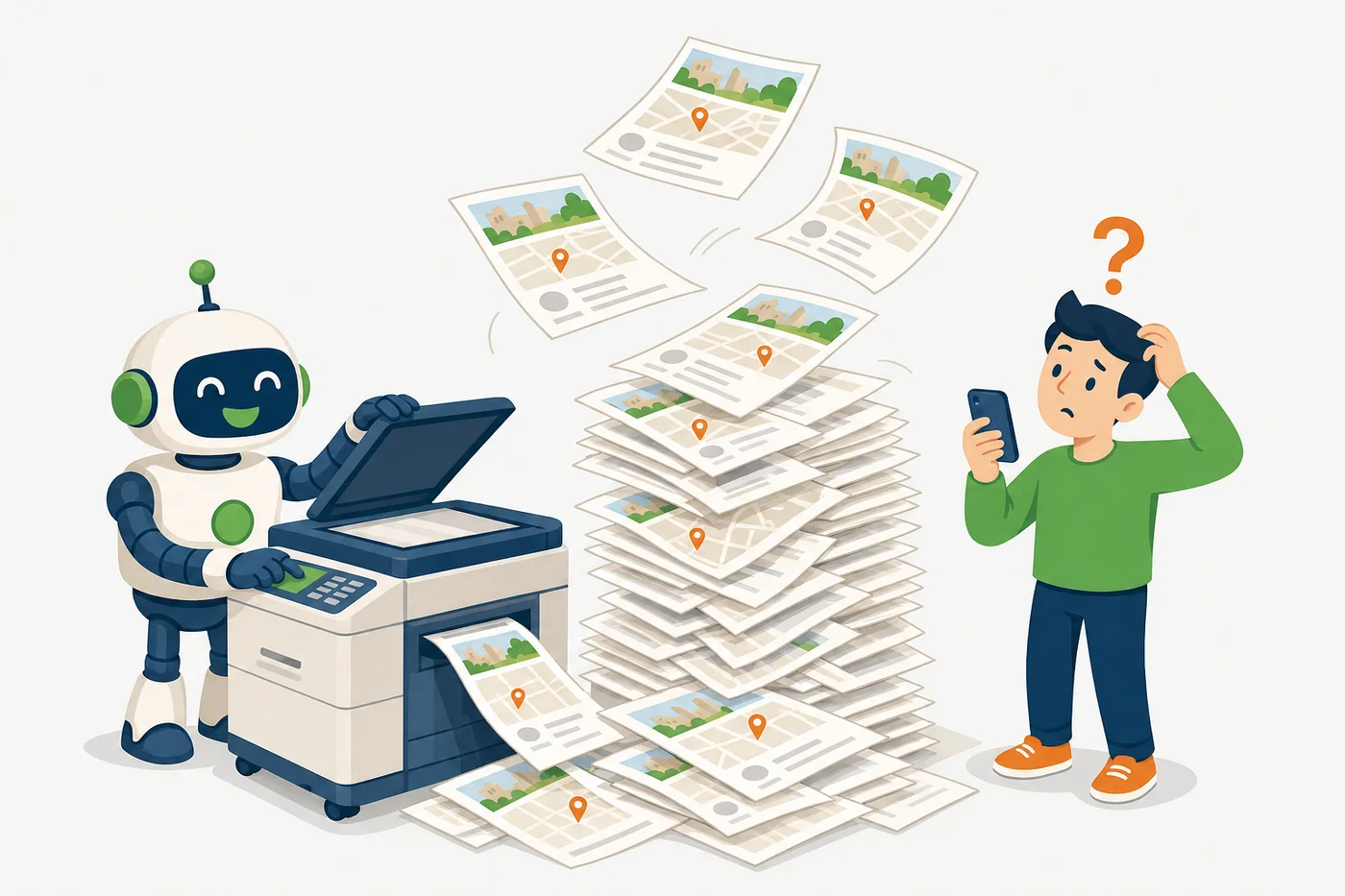
For a trade business, the classic version is the suburb page farm: 80 pages that say "best plumber in [suburb]", where the only thing that changes from page to page is the suburb name. AI makes those pages quick to produce, which is exactly why Google calls them out.
| Usually fine | Asking for trouble |
|---|---|
| A page for each service you actually offer, with your own prices, process and photos | Dozens of near-identical suburb pages with the name swapped |
| AI helping you outline a page, then you add the job detail | Pasting a full AI page live without reading it |
| One honest page for a service area you genuinely cover | Pages for suburbs you don't service, to catch the search |
| AI tidying the wording of a blog post you wrote | Publishing 30 AI blog posts a week on topics nobody asked you about |
| Real job photos with accurate alt text | AI images passed off as your own work |
A good test before you publish a location page: swap the suburb name for another one. If the page still makes complete sense, it isn't really about that suburb, and it's a candidate for scaled content.
How Google's Quality Raters Judge AI Content
Google's generative AI page points site owners to two sections of its Search Quality Rater Guidelines: section 4.6.5 on scaled content abuse, and section 4.6.6 on main content created with little to no effort, originality or added value.
Quality raters are people Google pays to check search results against these guidelines. Google is clear that their ratings "don't directly influence ranking". Instead, they help Google test whether its ranking systems are working. In other words, the guidelines tell you what Google is trying to reward and what it's trying to bury.
Section 4.6.6 says the Lowest rating applies when all or almost all of a page's main content is "copied, paraphrased, embedded, auto or AI generated, or reposted from other sources with little to no effort, little to no originality, and little to no added value for visitors to the website." Section 4.6.5 goes further: raters should rate pages Lowest when they strongly suspect scaled content abuse after looking at several pages on a site, "even if you are unsure of the method of creation".
That last part is worth reading twice. Raters don't need to prove AI was used. They judge the result, and they look across the site, not just one page.
AI Hallucinations: Why Every Fact Needs Checking
An AI hallucination is when a tool states something false as if it were fact. It happens because, as Google's new paragraph puts it, generative models "predict a likely sequence of words" rather than retrieve facts. The output sounds confident whether it's right or wrong.
On a trade website, hallucinations tend to show up in the details that matter most to a customer:
- Licences and standards. A licence class you don't hold, or an Australian Standard that doesn't apply to the job.
- Prices and timeframes. A "from $X" figure or a "same-day" promise you never gave.
- Warranties and guarantees. Years of warranty, or guarantees on outcomes, that you don't offer.
- Service areas. Suburbs you don't cover, listed because they sound nearby.
- Rebates and regulations. Government schemes and rules that change every year and are often stale in the tool's training data.
Google's page says the review applies to metadata too: page titles, meta descriptions, structured data and alt text. These are the bits nobody reads in the editor but customers see in search results. A wrong phone number in your structured data or a made-up suburb in your meta description can sit there for months.
AI Content And E-E-A-T: Who Wrote This?
E-E-A-T stands for experience, expertise, authoritativeness and trustworthiness. Google uses it to describe what its systems look for in helpful content, and its guide to creating helpful, people-first content suggests asking three questions of every page: who created it, how it was created, and why.
On the "who", Google's AI content FAQ recommends accurate author bylines "when readers would reasonably expect it", and says that giving AI an author byline "is probably not the best way" to be clear about AI's role. Its helpful content guide goes further on fake authors: "Fabricating creator profiles (such as by using AI-generated headshots, made-up names, or false credentials to make content appear as if it was written by human experts) is a form of deception."
For a trade business that's an easy line to stay on the right side of. Put your real name and photo on the page, talk about jobs you've actually done, and show real photos of your work. That's experience no AI tool can make up for you.
On the "how", Google suggests disclosing AI or automation "for content where someone might think 'How was this created?'" If you sell online through Google Merchant Center, it's a rule, not a suggestion: Merchant Center's AI-generated content policy says AI images must carry the IPTC DigitalSourceType TrainedAlgorithmicMedia metadata tag, and AI-written product titles and descriptions must be labelled as AI-generated.
How To Use AI For SEO Without The Risk
Google says generative AI "can be particularly useful when researching a topic, and to add structure to original content." That's the right way to think about it. Here's how we'd apply it to a trade website.
Use It As A Writing Assistant, Not The Writer
Get AI to help with an outline, a list of questions customers ask, or a tidier version of something you've written. Don't get it to write a whole page in one go and then proofread it. You end up editing the AI's idea of what the page should say, which is often not what the person searching actually wants, especially at the top of the page.

Start With What Only You Know
Before any AI is involved, write down the real details: what the job involves, what it usually costs, how long it takes, what goes wrong, which suburbs you cover, and a recent job you're proud of. That's the original content Google's guidance keeps referring to. AI can help you structure it, but it can't supply it.
Cut The Waffle
AI tools write long. A tradie's customer usually wants three things fast: can you do the job, roughly what will it cost, and how do I get hold of you. Trim anything that pushes those down the page, and keep the call to action easy to find.
Humanise AI Content With Real Photos And Video
Photos of your own jobs, your ute, your team on site and short phone videos do more to make a page feel human than any rewording. They also give Google something no other site has. Keep AI images for illustrations, never for "our work".
Build Fewer, Better Pages
One strong page per service and per area you genuinely cover beats a hundred thin ones. That's the approach behind our marketing for tradies and the way we plan a tradie website. This post is about using AI to write your pages. Getting quoted by AI search tools like ChatGPT is a different job, and our guide to generative engine optimisation vs SEO covers what changes there.
A Checklist Before You Publish AI Content
- 1Read every word. If you wouldn't say it to a customer on site, change it.
- 2Check every fact. Licences, standards, prices, warranties, timeframes, rebates and service areas.
- 3Check the hidden bits. Page title, meta description, image alt text and any structured data, including your phone number and address.
- 4Add something only you know. A real job, a real price range, a real photo.
- 5Run the suburb swap test on any location page. If it still reads fine with another suburb's name, rewrite it or don't publish it.
- 6Put a real person's name on it. Never a made-up author or an AI-generated headshot.
- 7Trim it. Make sure the call to action is easy to find on a phone.
- 8Watch it after launch. New pages take time to be indexed, and our guide to how long Google indexing takes covers what's normal.
Questions We Get About AI Content And SEO
Not by itself. Google's AI content FAQ says using AI "doesn't give content any special gains" and that useful, original content can do well however it's made. The risk is unchecked AI content, especially many similar pages published to chase rankings, which Google's spam policies call scaled content abuse.
Google's guidance doesn't publish a method for detecting AI text, and it doesn't need to. Its quality raters are told to give the Lowest rating to scaled, low-value content "even if you are unsure of the method of creation". The safer question is whether the page adds something real, not whether it would pass an AI content detection tool.
Google added a paragraph to its generative AI content guide explaining that AI models predict words rather than retrieve facts, so outputs may contain hallucinations, and that it's critical to manually fact-check and review all AI-generated content before publishing. That review covers page titles, meta descriptions, structured data and alt text.
Google suggests AI or automation disclosures where someone might reasonably ask "How was this created?" For a tradie's service page written with AI help and checked by you, a real name and real details usually matter more than a disclosure. If you sell through Google Merchant Center, AI images and AI product descriptions must be labelled under its AI-generated content policy.
Google says giving AI an author byline "is probably not the best way" to be clear about AI's role. Use the real person who checked and stands behind the content, and never a made-up author or AI-generated headshot, which Google's helpful content guide calls a form of deception.
Use it to research questions, plan a page and tidy wording, then add the details only you know: real jobs, real prices, real photos and the suburbs you actually cover. Check every fact and every line of metadata before it goes live, and build a small number of strong pages rather than lots of thin ones.
Ready For More Quality Leads?
Apply for the Lead Launch Program and start getting exclusive, high-intent enquiries sent straight to you, with no shared leads and no bidding wars.