
If your Google Business Profile isn’t performing the way it should, the problem usually isn’t effort. It’s misalignment. Google doesn’t randomly suppress businesses. It reduces visibility when it isn’t confident. Confidence comes from consistency.
Most local SEO problems are not caused by a lack of activity. They happen when Google sees conflicting information about a business across different places online. When that happens, Google becomes cautious. And when Google becomes cautious, visibility drops.
In a previous article, we explained why Google doesn’t trust certain businesses. This one is different. This is the framework we use when we audit a business properly and want to identify exactly where local SEO trust is breaking down.
Before we go further, we need to clear up one thing.
The Local SEO Trust Checklist
If your Google Business Profile rankings fluctuate or visibility suddenly drops, the most common cause is inconsistent business information across the internet.
- Your Google Business Profile, website, and directory listings must all match.
- Business name, phone number, and address inconsistencies reduce Google’s confidence.
- Structured data and website content should reinforce your primary service and location.
- Duplicate listings, outdated directories, and category mistakes weaken rankings.
- Stable local SEO happens when every signal about your business tells the same story.
This audit framework identifies exactly where trust breaks down so it can be fixed quickly.
What Local SEO Actually Is
Most people think local SEO means “optimising a Google Business Profile.” That’s incomplete.
Local SEO is three systems working together:
- Your Google Business Profile
- Your website
- Your off-site listings and brand signals
Google does not look at these in isolation. It compares them. If they reinforce each other, rankings stabilise. If they contradict each other, performance fluctuates.
So in this audit, we separate each layer clearly.
The Local SEO Trust Audit Framework
When we audit a business, we are not looking for “SEO opportunities.” We are looking for contradictions. Every inconsistency slightly reduces Google’s confidence in a business.
Across most audits, the same pattern appears. Rankings drop or fluctuate because different parts of the internet describe the business differently.
This is the quick framework I use before doing any advanced optimisation:
- Verify the Google Business Profile data
- Confirm website alignment with the profile
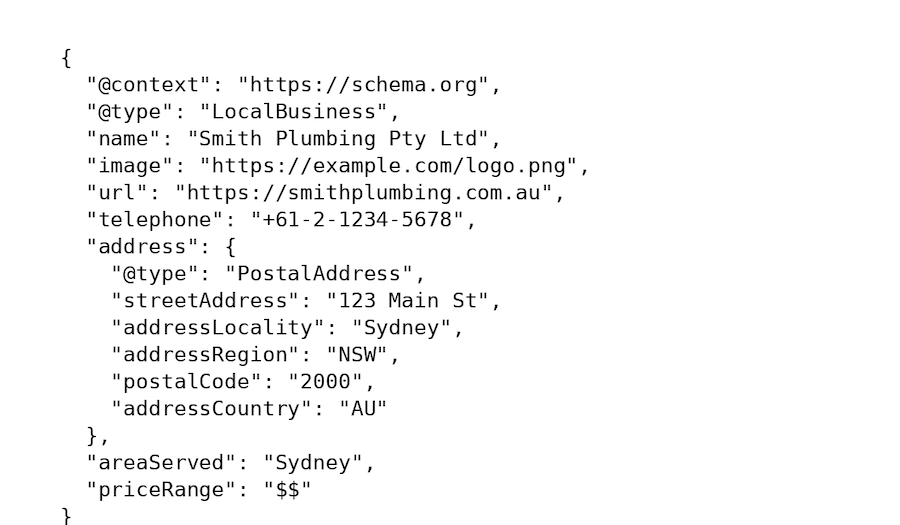
- Validate structured data
- Audit citations and directory listings
- Review behavioural signals like reviews and engagement
If these layers are clean and aligned, local SEO becomes stable. If they contradict each other, rankings fluctuate no matter how much optimisation you do.
Layer One: Your Google Business Profile
This is your visibility engine in Google Maps. This is where proximity, categories, reviews, and behavioural signals live. If this layer is inconsistent, nothing else matters.
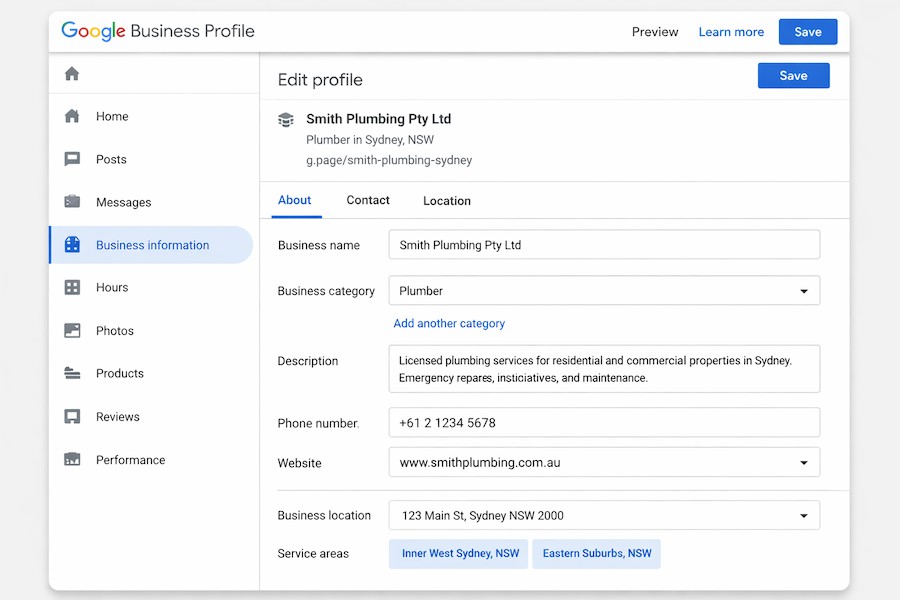
Your Business Name Must Be Identical Everywhere
This is one of the most common issues I see during audits.
The profile says:
Smith Plumbing Pty Ltd
The website says:
Smith Plumbing
The Facebook page says:
Smith Plumbing Services
That might feel minor. It isn’t. Google builds entity certainty from repetition. If your brand name shifts across platforms, you introduce ambiguity. Ambiguity lowers confidence.
Pick the correct version of your business name and standardise it everywhere.
Business Hours Are Not a Small Detail
If your Google Business Profile says 8 am to 5 pm but your website says 9 am to 5 pm, that is a conflict. Google cross-checks operational data across multiple sources.
When different platforms show different hours, Google does not assume one is correct. It reduces certainty. Local rankings are confidence-based. Small inconsistencies compound over time.
Address and Service Areas Need to Be Logical
If you operate from a physical location, your address must match exactly across:
- Google Business Profile
- Your website
- Structured data
- Directory listings
Same spelling. Same formatting.
If you are a service-area business, your address should usually be hidden in Google Business Profile. Your website should not contradict that by presenting you as a walk-in location.
Oversized service areas are another common problem. If you operate from one suburb, selecting an entire state does not make you look bigger. It makes you look unclear. Relevance beats ambition.
Categories Drive Your Ranking Direction
Your primary category tells Google what you are. Not what you might occasionally do. Not every service you offer.
What you are.
If your primary category does not reflect your highest value service, your positioning weakens immediately. Your homepage should reinforce the same service focus.
Google rewards clarity. Not vagueness.
Layer Two: Website Alignment
Your website reinforces the signals Google sees in your Google Business Profile. If the website tells a different story, rankings weaken.
During an audit, we check three things first.
- The homepage title clearly states the main service and location.
- The business name, phone number, and address match the Google Business Profile exactly.
- The main service described on the homepage aligns with the primary GBP category.
We also run the homepage through Google’s Rich Results Test to confirm the business schema matches the Google Business Profile information. Even small schema mismatches can create conflicting signals.
Layer Three: Structured Data
- Exact business name
- Address
- Phone
- Business hours
- Logo
Layer Four: Citations and Off-Site Signals
Google validates businesses by comparing information across the web. Directory listings, industry platforms, and social profiles all contribute to entity confidence.
The most common problems we see are:
- Old phone numbers are still listed in directories
- Previous business addresses are still indexed online
- Duplicate Google Business Profiles
- Different business names are used across platforms
Fixing citations is not about building hundreds of listings. It is about ensuring the important ones tell the same story.
Quick Audit Checklist
- Business name is identical across GBP, website, and directories
- Phone number is consistent everywhere online
- Address formatting is identical across all listings
- Primary category matches the main service
- Homepage title reinforces service and location
- Schema matches business information
- No duplicate Google Business listings
- Reviews are arriving consistently over time
A Real Example From an Audit
During one audit for a local contractor, rankings had dropped suddenly after several years of stability. The business had previously held a consistent position in the local map pack but had recently fallen outside the top results.
- An old phone number remained in the website footer
- Two directories still use a previous address
- The Google Business Profile category had recently changed
- The homepage title no longer referenced the primary service
Individually, these issues seemed small. Together, they created enough ambiguity for Google to lose confidence.
Once the business standardised its data across every platform and restored the correct service positioning, visibility stabilised over the following weeks, and enquiries began returning.
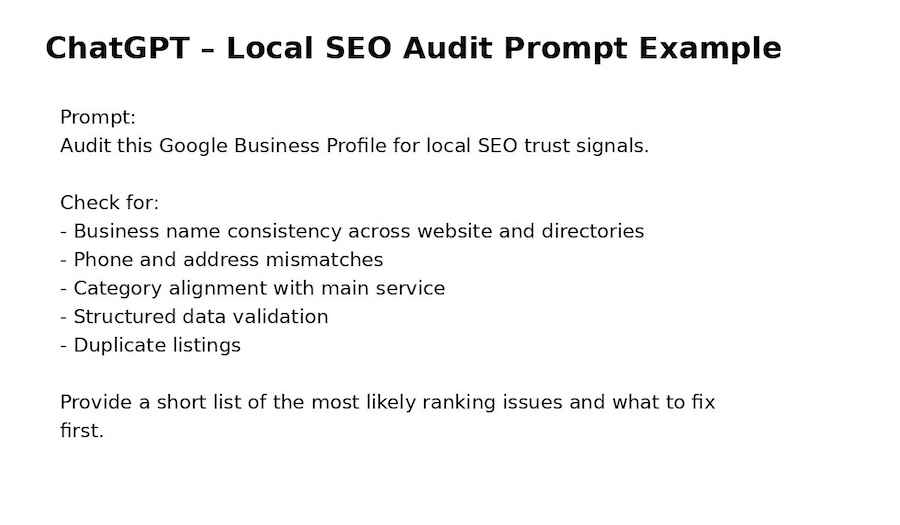
How I Use AI to Run This Audit Faster
- The Google Business Profile URL
- The website URL
- Schema markup if needed
- NAP inconsistencies
- Brand name variations
- Broken links
- Schema conflicts
- Trust risks
What We Fix First
Not all problems are equal.
Here’s the order we prioritise:
Stability Before Scale
We do not build links or increase posting frequency until the structure is clean. Growth amplifies what already exists. If the foundation is unclear, growth amplifies instability. A Google Business Profile audit is not about doing more. It is about removing contradiction.
Local SEO works when your Google Business Profile, your website, and your off-site signals all tell the same story. When that story is consistent, Google becomes confident. When Google becomes confident, visibility stabilises.
If you want a structured audit that identifies exactly where trust is breaking down and what to fix first, and to experience real results, Get in touch with us at The Lead Gen Lab and explore the Lead Launch Program.
Clear structure. Clear priorities.
Ready For More Quality Leads?
Apply for the Lead Launch Program and start getting exclusive, high-intent enquiries sent straight to you, with no shared leads and no bidding wars.