
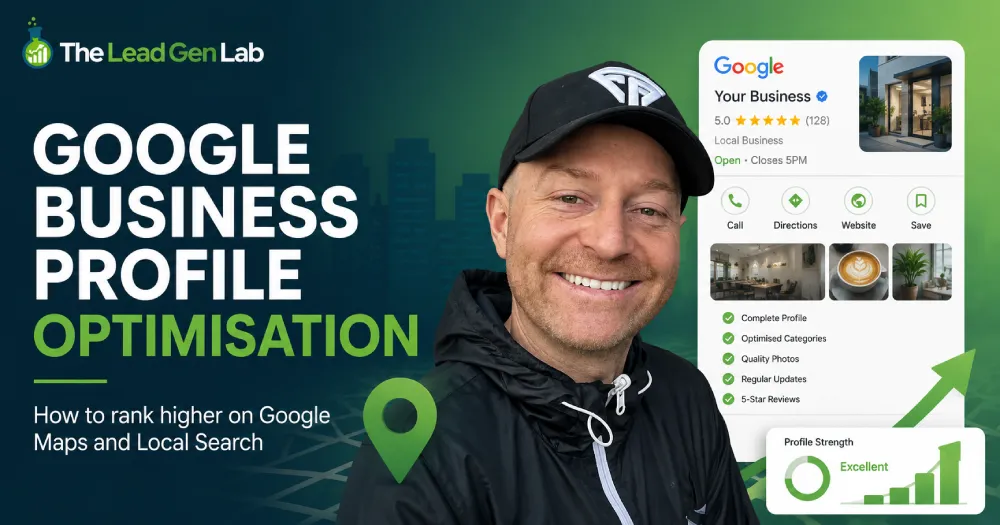
Google loses trust in your business when your location data, service areas, online listings, and real-world behaviour don’t line up. When Google sees conflicting signals, it treats your business as a risk. When Google assumes risk, your visibility drops. This isn’t an SEO problem. It’s a trust problem, and it’s the core issue behind underperforming Google Business profiles and inconsistent Google Maps rankings.
Business owners are investing in SEO while their Google Business profile quietly underperforms. The listing exists. The website looks professional, yet visibility metrics are low, local map pack rankings never stabilise, and enquiries are not consistent. Not because the business isn’t legitimate, but because from Google’s perspective, the signals don’t form a clear, verifiable picture of a trustworthy local business entity.
At The Lead Gen Lab, we focus on fixing that clarity gap. We work on local search foundations such as NAP consistency, accurate local citations, and realistic service areas; the parts Google actually uses to decide whether a business deserves ongoing visibility in local search results. This article explains how Google evaluates, where businesses lose credibility, and what actually restores it.
How Google Decides Who Shows Up
- Local rankings depend on trust, not optimisation tricks
- Conflicting signals reduce certainty and visibility in Google Maps
- Most Google Business profile issues are structural, not technical
- Service areas must be realistic and defensible for service area businesses
- Ongoing activity supports trust over time through behavioural signals
- Clean foundations make stable Google Maps rankings possible over time
Google Is Sceptical by Design
Google isn’t designed to help businesses rank. It’s designed to protect search results. Every local listing and Google Business profile reflects on Google’s credibility as an information provider. If a user contacts a business that doesn’t show up, can’t deliver, or doesn’t match its claims, that failure reflects on Google. As a result, the platform defaults to caution when determining local search visibility.
Google favours businesses that appear real, present, easy to verify, and consistent over time. Anything unclear or contradictory reduces confidence and can weaken the ranking of a company.
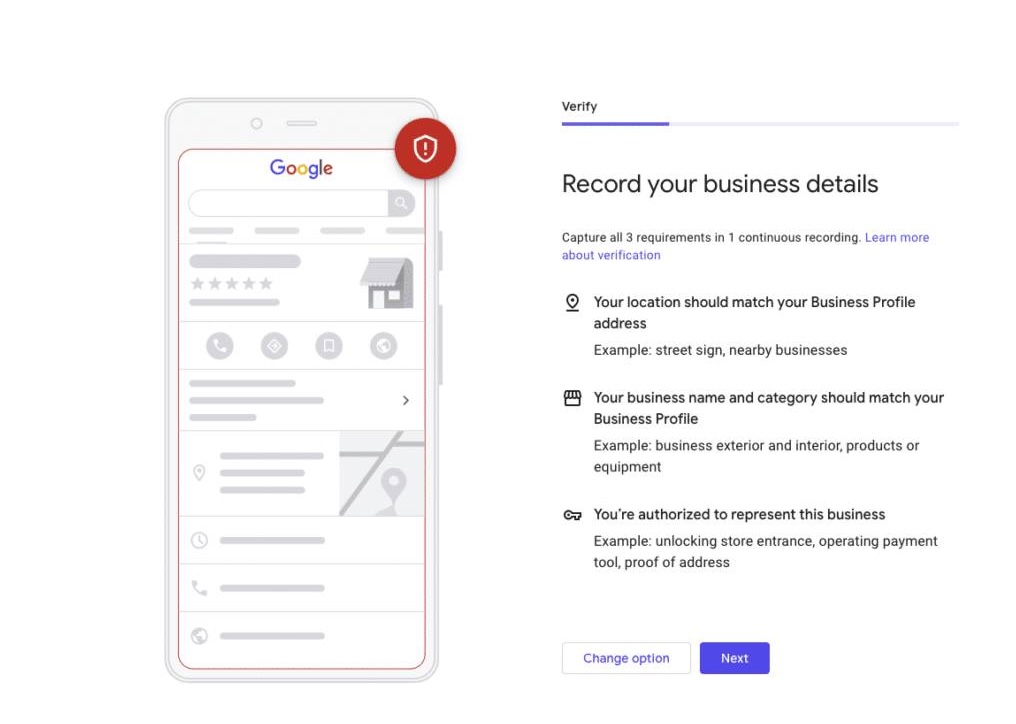
This scrutiny is stronger for service-based businesses, home-based or residential addresses, new listings, businesses expanding into new areas, and profiles with changing or inconsistent data. These businesses aren’t penalised, they’re simply assessed more carefully based on local SEO trust signals.
Ranking Is a Confidence Decision
Many business owners assume rankings improve by adding more keywords, more content, or more optimisation.
But Google Business profiles rarely underperform because of a lack of effort. They underperform when Google can’t confidently answer basic questions about the business, and that directly impacts local search visibility.
At a practical level, Google is trying to understand where the business is based, where it realistically operates, whether it is currently active, how customers interact with it, and whether that information stays consistent over time through NAP consistency.
Confusing Information Is the Silent Blocker
One of the most common issues we see is simple: the business structure doesn’t clearly explain itself to Google. This is where Google Business profile optimisation breaks down, even affecting established businesses just as often as new ones.
Common Structural Issues That Reduce Trust
- Listings are scattered across directories with conflicting details
- Old local citations are tied to previous names or locations
- Duplicate or abandoned Google Business Profiles
- Inconsistent phone numbers or addresses affecting NAP consistency
- Service areas that don’t match the physical base
- Profiles with little ongoing engagement or behavioural signals
Individually, these issues often seem harmless. Together, they create uncertainty.
How NAP Consistency Affects Google Maps Rankings
NAP consistency stands for Name, Address, and Phone number consistency. It’s simple in theory, but it’s one of the most common causes of unstable Google rankings. Google cross-checks your business details across directories, social platforms, and data sources. When those details match everywhere, confidence increases. When they don’t, it becomes a red flag.
Common issues include:
- Old addresses are still listed online
- Slightly different business names
- Inconsistent phone numbers
- Outdated website URLs
Can Duplicate Listings Hurt Your Google Business Profile?
Yes. Duplicate listings split authority. When multiple profiles exist:
- Reviews divide
- Engagement fragments
- Google struggles to identify the primary entity
Duplicates often appear after moves, name changes, or ownership transitions. Some are legacy listings that were never cleaned up. From Google’s perspective, duplicates create confusion.
Why Local Citations Matter for Map Pack Rankings
Local citations are mentions of your business name, address, and phone number across trusted directories. When reputable platforms consistently display accurate information, they reinforce legitimacy and strengthen entity recognition.
Strong citations:
- Support NAP consistency
- Confirm physical presence
- Improve local confidence
Outdated or inconsistent listings weaken that trust over time. Citations alone won’t drive rankings, but without them, Google has fewer external signals to verify your business. Clean, aligned citations reduce noise and support stable map pack visibility.
A Real Example: Connect Business Insurance

Connect Business Insurance is an established business with a physical office in Wembley, Perth. They’ve been operating for years, have a proper team in place, and work with real clients who leave genuine reviews. Despite that, their Google presence was underperforming.
When we reviewed how Google interpreted the business, the signals wouldn’t line up in a way the platform could easily understand or trust. Specifically, we found:
- Fragmented and outdated listings across the web
- Local citations pointing to incorrect or legacy business entities
- A Google Business profile configured to target the entire country rather than its realistic service footprint
- Little ongoing activity on the profile itself
What Business Owners Think vs What Google Verifies About Your Google Business Profile
| What the business owner assumes | What Google actually evaluates |
|---|---|
| “We’ve operated for years” | Whether old listings, citations, and entities still point to accurate information |
| “Our address is legitimate” | Whether the same address appears consistently across trusted sources |
| “We cover a wide area” | How relevant the business is to any one location based on proximity and behaviour |
| “Our profile is active” | How frequently and consistently do real interactions occur? |
| “Customers know we’re real” | Whether Google can verify real-world activity through data and engagement |
Activity Confirms Legitimacy Over Time
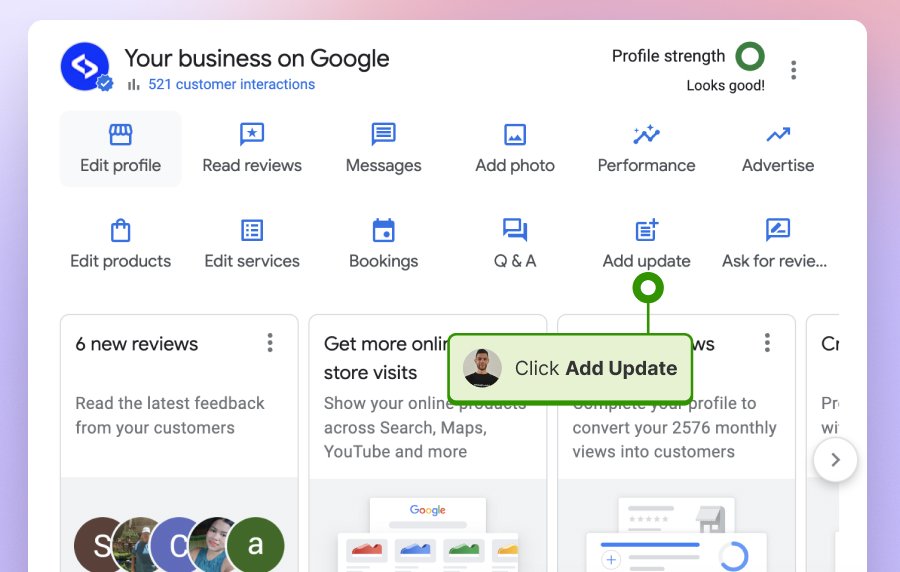
Many businesses treat activity as a credibility factor. Actions such as posting updates, uploading photos, and responding to reviews help with showing legitimacy and support local search rankings.
From Google’s perspective, these actions confirm that the business is operating now, the listing is actively managed, customers interact with it naturally, and the behaviour looks human.
Reviews Are Ranking Signals
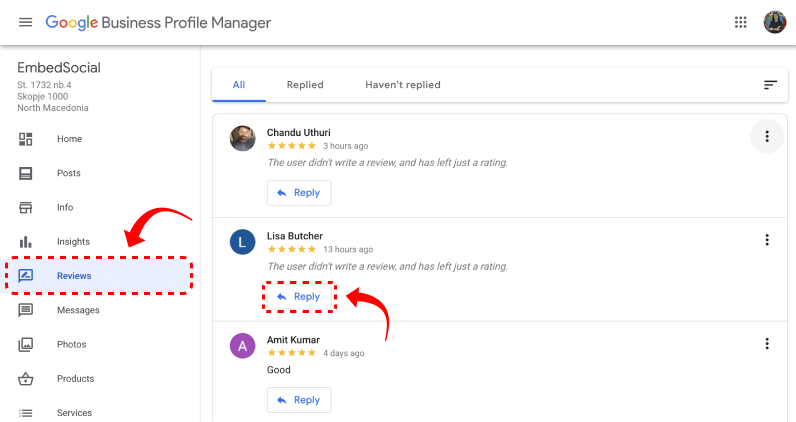
Most businesses think of reviews as social proof. In our experience, Google treats them as behavioural data within your Google Business profile.
It pays attention to how often reviews arrive, how recent they are, how detailed they appear, whether photos are included, and how natural the language looks across multiple reviewers. Together, those factors help Google understand whether a business is active and engaging with real customers right now, which supports local search rankings.
That’s why proactive review collection matters, especially when launching or stabilising a listing. From Google’s perspective, reviews signal that real customers exist, and real interactions are happening.
Service Areas: Where Trust Is Often Lost
Service areas are one of the most misunderstood elements of local search for service businesses.
Many businesses assume that a wider service area creates more opportunities. In practice, oversized service areas often weaken local search rankings by reducing relevance. When coverage stretches beyond what’s realistic for a physical base, Google becomes cautious. Local performance improves when service areas are logical, defensible, and supported by real-world behaviour and reviews.
Do Service Area Businesses Rank Differently on Google?
Yes, because proximity signals work differently. When you hide your address and operate as a service business, Google relies heavily on reviews, engagement, and location-based behaviour.
Many businesses weaken their rankings by selecting oversized service areas. Choosing entire states or the whole country reduces local relevance.
The Wembley Listing’s Biggest Structural Mistake
Connect Business Insurance’s Wembley office is a legitimate, long-standing physical location. There was nothing questionable about the business itself. The problem was how the Google Business Profile was configured.
Instead of being positioned clearly as a local Perth-based business, the profile was set up to target the whole of Australia. From Google’s perspective, that creates immediate conflict. A single physical address was asking to be treated as a national provider, without the supporting structure or the trust signals to justify it. What Google saw didn’t line up.
The fix required stripping the service area down to:
- The most relevant nearby locations
- A tight radius around the Wembley office
- Areas the business could realistically support and demonstrate activity in
Once that happened, the signals aligned. The address, service areas, behaviour, and proximity all pointed in the same direction. That’s when Google could clearly understand where the business belonged, improving local search visibility.
What to Fix First
If your Google Business profile isn’t performing as well as you expected, don’t try to fix everything at once. Start with the fundamentals that affect local SEO trust signals the most.
| Action Items | Why It Matters |
|---|---|
| Consistent NAP details | Google trusts businesses with matching information everywhere |
| Remove duplicate listings | Confusion drops your visibility |
| Tighten service areas | You rank where you actually work |
| Keep your profile active | Activity signals show you’re open and operating now |
| Fix the structure before growth | Traffic won’t help if the foundation is weak |
What Success Actually Looks Like
New listings don’t take off overnight. They index gradually and build trust through consistent signals over time. The goal in local search isn’t instant rankings, it’s stability.
Google Business, when profiles are done right, provides a listing that stays live, continues to index, and shows steady signs of activity. Engagement accumulates naturally, reviews arrive over time, and relevance strengthens as the signals align. When that happens, visibility stops fluctuating, and enquiries become more predictable.
The Free Leverage Most Businesses Ignore
Once the structure is fixed, Google gives you something most businesses never take advantage of: ongoing distribution without paid spend. Google Business profile updates, photos, short videos, Q&A activity, and offers aren’t optional extras. They’re how Google gauges whether a listing is still active and worth showing. When these signals are present, the listing looks alive.
In practice, a small amount of consistent activity goes a long way. Ten minutes a week is often enough to reinforce that the business is operating, being managed, and interacting with customers. This is why it’s good to work with companies that know how Google works. The consistency they can provide supports engagement, stabilises local search visibility, and increases the likelihood of calls.
This is also why weaker competitors sometimes outperform better businesses. Not because they’re superior operators, but because they show up more consistently.
Trust Comes Before Rankings
Google reduces visibility when it can’t clearly understand a business. When locations, service areas, data, and behaviour don’t align, Google assumes risk and limits exposure. The solution is a clean structure, realistic service areas, consistent business data, ongoing natural activity, and signals that reinforce each other everywhere Google looks.
Ready to Be More Visible?
We’ll review your setup, show you where trust is breaking down, and explain what to fix first. No vague recommendations. Just clear answers and a practical path forward. Get in touch with us today.
Two Ways To Win From This
Stay Visible In AI Search, Or Just Take The Leads
Do the work yourself and be the business the AI tools quote when somebody asks for your trade in your city. That is what everything above is for.
Or skip the build entirely and take the enquiries we already generate, exclusive to you, no shared leads and no bidding wars.
Either way, the fastest start is a conversation. Ring me and we will work out which one suits you.