
Lead generation is one of the most talked-about concepts in marketing, yet it’s often misunderstood or reduced to a handful of tactics like ads, SEO, or social media. At its core, lead generation is much simpler and much older than most people realise.
It’s the process of capturing attention and turning that attention into interest from potential customers.
What has changed over time is not the principle, but the tools. From physical marketplaces and printed posters to search engines, YouTube, and mobile apps, businesses have always been competing for attention in the places where people already are. Understanding this distinction is what separates random marketing activity from a structured lead generation strategy.
In this guide, we’ll break down what lead generation actually means, why it works, how it has evolved over time, and how to approach it in a way that remains effective regardless of platform shifts.
What Is Lead Generation?
Lead generation, often confused with general marketing services, is the process of attracting and capturing interest from potential customers for a product or service. A “lead” is simply someone who has shown some level of interest. That could be:
- Filling out a form
- Calling a business
- Subscribing to a list
- Clicking on a piece of content
- Responding to an offer
So when people ask what lead generation means, they’re really asking how businesses consistently create opportunities for sales conversations.
In practice, this can take many forms.
Online, it might look like:
- A website organically ranking on Google or in AI for a high-intent search
- A YouTube video answering a specific problem
- An email capturing interest through a relevant offer
- A local Google My Business listing capturing foot traffic
Offline, it could be:
- A poster in a high-traffic location
- A flyer with a clear call to action
- A billboard placed where attention is concentrated
The method changes, but the mechanism stays the same. Lead generation is not tied to a platform. It’s tied to the ability to get in front of the right people and give them a reason to respond.
The Core Principle Behind Lead Generation
If you strip everything back, all lead generation is built on one idea: Attention. Where attention exists, lead generation is possible.
This is why businesses have always placed themselves in high-traffic environments:
- Busy marketplaces in early commerce
- Newspaper ad placements
- Radio and television slots
- Search engines and social platforms
The goal is always the same: to position a message where people are already looking. However, attention alone is not enough. Two additional factors determine whether attention turns into leads.
1. Placement
Being in the right place matters more than being everywhere. A message shown to the wrong audience, even at scale, produces little value. But a well-placed message in front of a highly relevant audience can consistently generate leads.
This is where concepts like buyer intent keywords, targeted content, and local placements come into play.
2. Leverage
Leverage is what separates manual effort from scalable lead generation.
At one end, you have direct, one-to-one methods:
- Door knocking
- Cold outreach
- Physical distribution
On the other hand, you have leveraged systems:
- Search engines and AI
- Video platforms
- Email databases
- Mobile communication channels
- Social media
The difference is simple. Without leverage, you are limited by time and effort. With leverage, your message can reach thousands of people without increasing workload.
This is why modern lead generation strategies focus heavily on systems that continue working after the initial setup.
3. Conversion of Attention Into Action
Attention only becomes valuable when it leads to action.
That action might be:
- An enquiry
- A click
- A call
- A sign-up
This is where elements like the following start to matter:
- Messaging
- Offer structure
- User experience
If attention is the entry point, conversion is the outcome.
The History of Lead Generation (Why It Still Works Today)
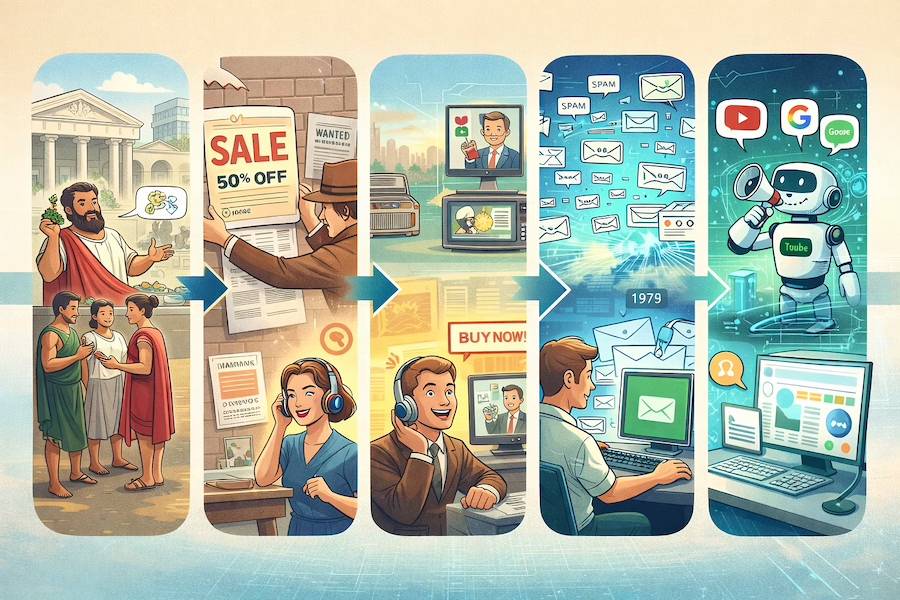
To understand why lead generation works so reliably today, it helps to look at where it came from. Long before digital marketing, businesses were already competing for attention in physical environments.
In early marketplaces, like Rome’s Trajan’s Market, traders positioned themselves here due to the high-traffic to increase visibility. The principle was simple: the more people who saw your offer, the higher the likelihood of generating interest.
As communication evolved, so did the methods.
Printed newspapers introduced the ability to reach larger audiences through paid placements. Posters and billboards extended this further, allowing businesses to place messages directly in public spaces where attention was already concentrated.
Then came broadcast media.
Radio and television gave businesses access to mass audiences at scale. The first radio ad aired on August 22, 1922, in the United States. New York station WEAF sold a 15-minute commercial slot to the Queensboro Corporation, promoting apartments in Jackson Heights. At the time, this format was known as “toll broadcasting.” The first television ad was for Bulova watches, an American watchmaker. The 10-second advertisement appeared on July 1, 1941 on the US channel NBC, before the broadcast of a baseball game between the Brooklyn Dodgers and the Philadelphia Phillies. With the launch of advertising on broadcast, a single message could now reach thousands or even millions of people simultaneously, dramatically increasing the potential for lead generation.
As technology progressed, new formats continued to emerge:
- Books and printed materials are used to educate and attract interest
- Early email campaigns enabling direct communication at scale
- Infomercials combining education with persuasion over longer formats
Each of these innovations followed the same underlying structure:
- Find where attention exists
- Place a message in that environment
- Give people a reason to respond
The tools changed, but the mechanics didn’t. This is the key insight. Lead generation is not a modern invention. It’s a consistent pattern that has adapted to every new communication channel introduced over time.
How Lead Generation Has Evolved (Leverage & Scale)
While the core principles have remained stable, the biggest shift in lead generation has been the increase in leverage.
In earlier models, generating leads required significant manual effort. Whether it was face-to-face selling, distributing printed materials, or making direct contact, reach was limited by time and physical constraints.
As new technologies emerged, that limitation began to disappear.
Digital platforms introduced the ability to:
- Reach large audiences instantly
- Target specific groups with greater precision
- Deliver messages across multiple channels simultaneously
Search engines changed how people find information. Instead of businesses pushing messages outward, users began actively searching for solutions. This created a major shift towards intent-driven lead generation.
Platforms like video sharing sites and content networks extended this even further. A single piece of content, if positioned correctly, could continue generating leads over time without ongoing input.
At the same time, communication became more direct and immediate.
Email, SMS, and mobile applications allowed businesses to:
- Stay in front of their audience
- Maintain ongoing communication
- Build owned channels rather than relying entirely on third-party platforms
This shift introduced an important strategic consideration.
While third-party platforms provide reach, they also come with dependency. Changes in algorithms, policies, or platform direction can affect visibility and access to audiences.
As a result, more robust lead generation strategies now combine:
- Platform-based visibility (search, social, video)
- Owned audience channels (email lists, mobile communication)
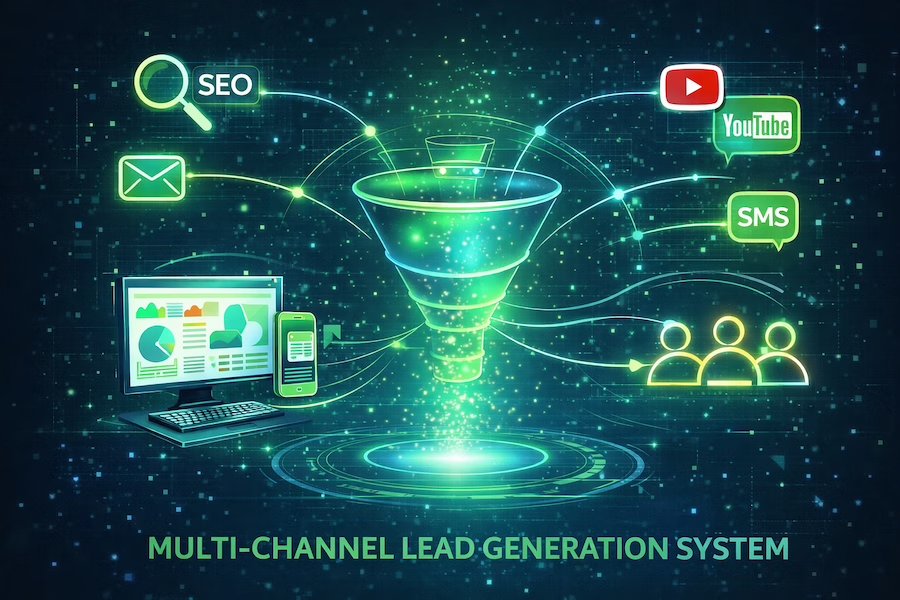
Another key development is the concept of multi-channel integration. Rather than relying on a single source of leads, businesses now connect multiple channels together. For example:
- A search result leads to a website
- The website captures an email
- Follow-up happens through email or SMS
- Additional content reinforces engagement
This creates a system rather than a series of isolated tactics. The outcome is not just more leads, but more consistent and controllable lead flow.
Modern Lead Generation Channels (And How They’ve Shifted)
The number of lead generation channels available today is higher than at any point in history. But more importantly, the way people find, consume, and act on information has fundamentally changed, especially with the rise of AI-driven platforms.
The key shift is this:
It’s no longer just about being visible. It’s about being selectively visible at the moment of intent.
Let’s break down the major channels as they exist today.
Search (SEO + AI Search Layers)
Search is still one of the highest-intent lead generation channels available, but it’s no longer just about ranking on traditional search engines.
You now have:
- Google search results
- AI-generated summaries and answer engines
- Alternative search platforms
- Voice and conversational search
The implication is clear. Ranking alone is not enough.
Your content needs to:
- Be structured for clarity
- Directly answer specific queries
- Align with buyer intent keywords
Auditing your Google Business Profile and company website SEO can help you discover how your business can become more visible and perform better on Google search results.
YouTube (Search + Discovery Combined)
YouTube continues to function as both:
- A search engine
- A discovery platform
A well-positioned video can act like an ongoing advertisement, but unlike traditional ads, it’s:
- Intent-driven
- Searchable over time
- Capable of compounding visibility
The analogy here is simple:
A properly targeted YouTube video is closer to a permanent, searchable TV commercial than a one-time campaign.
Owned Audiences (Email, SMS, and Direct Channels)
One of the biggest strategic shifts in recent years is the renewed importance of owned audiences.
These include:
- Email lists
- SMS databases
- Mobile app users
Unlike third-party platforms, these channels allow you to:
- Communicate directly
- Maintain visibility without algorithms
- Build long-term relationships
As platforms evolve and policies change, owned channels provide stability. They are not a replacement for visibility channels, but they are a critical complement.
AI and Leverage
Leverage has always been the defining factor in lead generation. The businesses that grow fastest are not the ones doing the most manual work, but the ones using systems to multiply their reach.
AI is the latest version of that leverage. It doesn’t change the core principle of lead generation. It simply makes execution faster, more scalable, and more efficient.
With AI, businesses can:
- Create content at a much higher speed
- Identify high-intent search opportunities faster
- Optimise messaging based on real data
- Repurpose one idea across multiple platforms
This dramatically reduces the time between idea and execution.
But there’s an important shift happening.
As AI makes content easier to produce, volume is no longer an advantage. Anyone can create content. Very few create content that actually generates leads.
This means the focus moves away from output, and towards:
- Relevance to real customer problems
- Positioning in high-intent environments
- Clarity of message and offer
AI is not a shortcut to results. It’s a multiplier.
If the strategy is weak, AI will scale the wrong things faster. If the strategy is sound, AI can significantly increase lead flow without increasing workload.
Offline Channels (Still Relevant, Still Underused)
Despite the shift to digital, offline lead generation has not disappeared.
In many local markets, it remains underutilised.
Examples include:
- Posters in high-traffic locations
- Local partnerships
- Physical placements in community spaces
The advantage is often reduced competition.
While most businesses focus exclusively online, attention still exists in physical environments.
The Real Takeaway
All of these channels have one thing in common:
They are simply different containers for attention.
The businesses that generate leads consistently are not chasing every new platform.
They are identifying:
- Where attention currently exists
- How to position themselves within it
- How to connect those channels into a system
What Most Businesses Get Wrong About Lead Generation
Most businesses don’t struggle because of a lack of options. They struggle because of how they approach those options. The most common mistake is treating lead generation as a collection of disconnected tactics.
This often looks like:
- Running ads without a clear strategy
- Posting content without intent targeting
- Trying multiple platforms without consistency
The result is predictable.
Inconsistent results, unclear performance, and a reliance on trial and error.
Another common issue is misalignment with intent. Not all attention is equal. A large volume of low-relevance traffic will almost always underperform compared to a smaller, highly targeted audience.
This is where many efforts break down.
Instead of focusing on:
- Who is searching
- What they are searching for
- Why are they searching
Businesses focus on:
- Volume
- Visibility for its own sake
- Surface-level engagement
There is also a growing dependency on single platforms.
A business introduces risk when they rely entirely on:
- One traffic source
- One platform
- One method
Platform changes, policy shifts, or increased competition can quickly reduce effectiveness.
How to Approach Lead Generation Strategically
A more effective approach to lead generation is not built on individual tactics, but on structure.
At a high level, this means thinking in terms of systems rather than activities.
1. Start With Intent, Not Channels
Before choosing a platform, identify:
- What your ideal customer is searching for
- What problems are they trying to solve
- What stage of awareness are they in
This is where buyer intent keywords become critical. They allow you to position your content where demand already exists.
2. Build Around Core Channels
Rather than spreading effort across every platform, focus on a small number of core channels such as:
- Search
- Video
- Direct communication (email/SMS)
These can form the foundation of a multi-channel lead generation system.
3. Connect Channels Into a System
Instead of isolated efforts, channels should work together.
For example:
- A search query leads to a page
- The page captures contact details
- Follow-up continues through email or SMS
- Additional content reinforces the relationship
This creates continuity rather than fragmentation.
4. Prioritise Consistency Over Complexity
Many lead generation strategies fail because they are overly complex. A simple, well-executed system will outperform a complex, inconsistent one.
Consistency builds:
- Data
- Optimisation opportunities
- Predictability over time
5. Reduce Platform Dependency
Where possible, balance:
- Platform-based traffic (search, social, video)
- Owned audiences (email, SMS, apps)
This reduces risk and increases control.
What Comes After Lead Generation
Generating a lead is only the first step. A lead represents interest, not revenue.
What happens after that initial interaction is what determines whether lead generation efforts actually produce business outcomes. This is where many businesses fall short.
They focus heavily on:
- Traffic
- Visibility
- Enquiries
But give far less attention to:
- Follow-up speed
- Sales process
- Communication quality
In practice, converting leads requires structure.
This may include:
- Clear response processes
- Defined sales conversations
- Ongoing follow-up sequences
- Systems to track and manage interactions
Without this layer, even high-quality lead generation can underperform.
There is also a timing factor. In many cases, leads are not ready to act immediately. This is where continued communication becomes important.
Channels like email and SMS allow businesses to:
- Stay visible over time
- Provide additional value
- Re-engage prospects when they are ready
The key point is simple. Lead generation creates opportunity. Conversion systems turn that opportunity into results.
Why Lead Generation Will Never Go Away
If you look back across every stage of its evolution, one pattern becomes clear. Lead generation adapts, but it does not disappear.
From physical marketplaces to digital platforms, from printed materials to AI-driven discovery, the underlying dynamic remains the same.
Businesses need attention. Customers need solutions.
As long as those two conditions exist, lead generation will continue in one form or another.
What changes is:
- Where attention is concentrated
- How messages are delivered
- How quickly does communication happen
We’ve already seen this progression:
- Direct communication methods are evolving into digital messaging
- Mass media evolving into targeted content
- Static content evolving into interactive and AI-assisted formats
And this will continue. New platforms will emerge. Existing platforms will shift. User behaviour will evolve.
But the core mechanism will remain stable. This is why a strategy built on principles, not just platforms, is more durable over time.
Where to Go From Here
Understanding what lead generation is and how it works is one thing. Building a system that produces consistent, high-quality leads is another.
The difference usually comes down to:
- Strategy
- Structure
- Execution over time
If you’re looking to move beyond scattered tactics and build a more reliable lead generation system, that’s exactly what we focus on at The Lead Generation Lab.
Two Ways To Win From This
Stay Visible In AI Search, Or Just Take The Leads
Do the work yourself and be the business the AI tools quote when somebody asks for your trade in your city. That is what everything above is for.
Or skip the build entirely and take the enquiries we already generate, exclusive to you, no shared leads and no bidding wars.
Either way, the fastest start is a conversation. Ring me and we will work out which one suits you.