
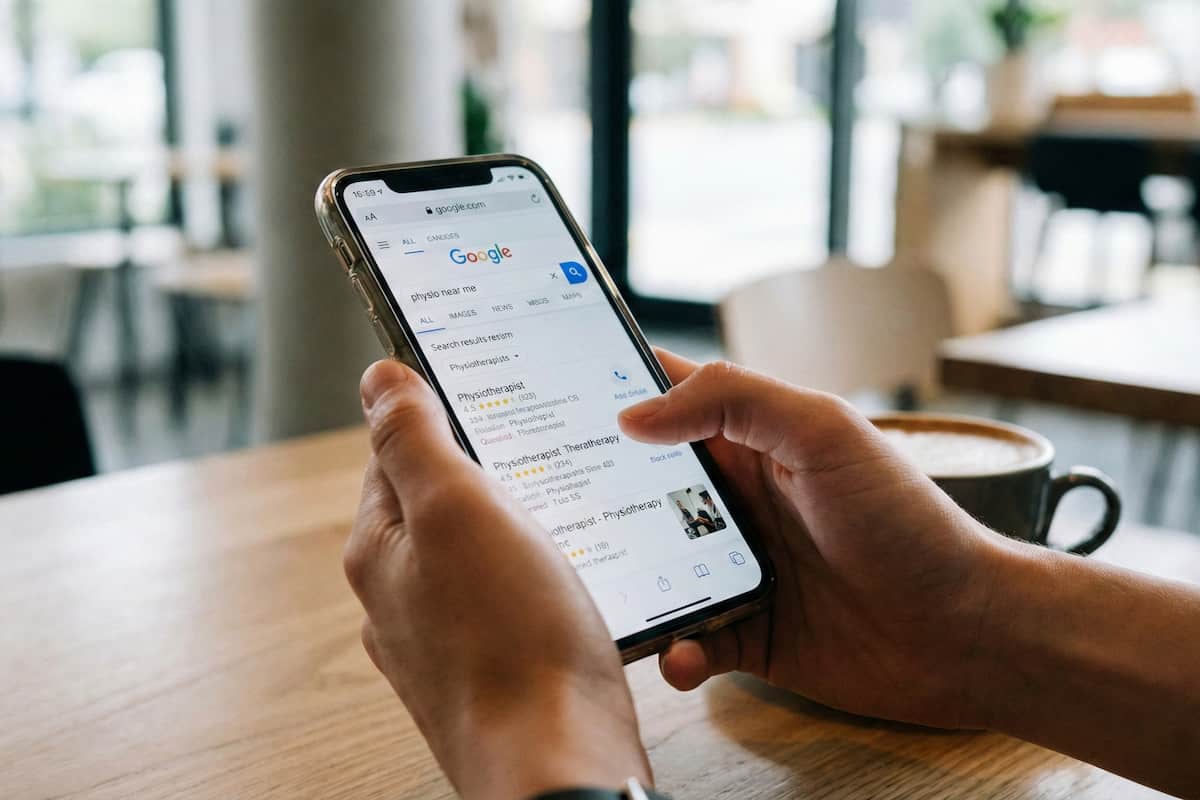
If you run a healthcare or wellness business, word of mouth is powerful, but it is not enough on its own. Many people do not discuss sensitive health concerns with friends or family. They search privately on Google instead.
Local SEO helps your practice show up when someone nearby searches for the services you offer, the symptoms they are experiencing, or the problem they want solved. It is one of the most effective ways to generate consistent enquiries without relying solely on paid ads.
This guide breaks local SEO down into practical steps you can implement to improve visibility in Google and drive more enquiries.
What is SEO (and why it matters for clinics)?
SEO stands for search engine optimisation. It is the process of improving your online presence so you appear more often, and higher, in search results.
The major advantage is that SEO is organic, meaning you are not paying for every click the way you do with Google Ads. When your SEO foundations are strong, you can reach people who would never have found you otherwise.
SEO also supports referrals. Even when someone is referred to your practice, they often still Google you. Showing up clearly, with trust signals, creates “green lights” that lead to bookings.
What is Local SEO?
Local SEO is a specific branch of SEO that uses physical location as a ranking factor.
It connects:
- your website domain (your practice website)
- the services you offer
- and the location you serve
When someone searches locally, Google tries to show the best local options based on three core factors:
- 1Relevance: how closely your listing matches what the person searched for
- 2Distance: how close your practice is to the searcher’s location
- 3Prominence: how established and trustworthy your business appears online
Local SEO is most applicable to brick-and-mortar businesses with a real physical location patients can visit.
How the “Map Pack” Works (and why rankings vary by street)
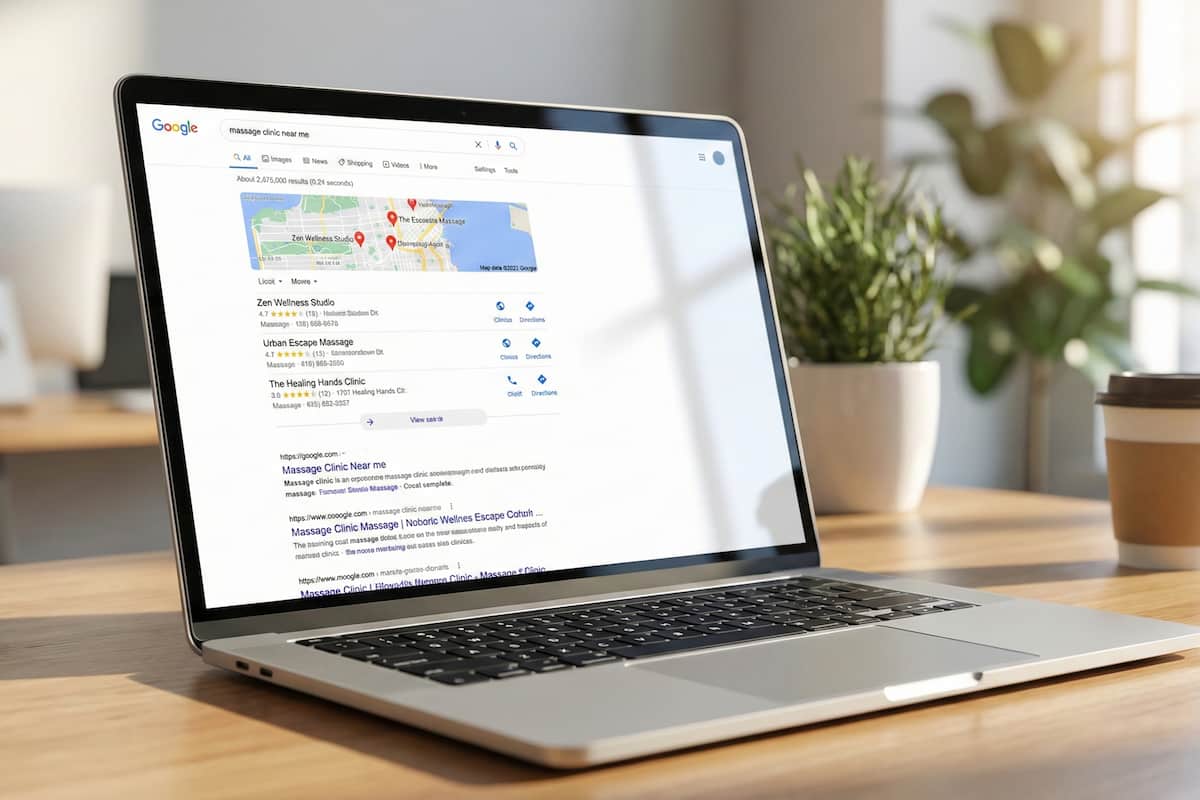
For many local searches, Google shows the Map Pack (the map results) near the top of the page. This is the prime real estate for clinics.
A crucial point: local rankings can shift dramatically within a few blocks.
A practice might be:
- #2 in one part of town
- #7 only a short distance away
- or not visible at all in a nearby pocket
That is normal. Local SEO is highly location-sensitive. This is also why “having a website and Google Business Profile” is not enough. If every competitor has those basics, Google still needs a way to decide who deserves the top spots.
Step 1: Nail Your Ideal Client (this drives your SEO)
Your ideal client is the backbone of your:
- website copy
- service pages
- blog content
- local SEO strategy
If your messaging tries to speak to everyone, it often speaks to no one. Focus builds consistency and credibility, and Google rewards that.
The Ideal Client Exercise (SEO-focused)
Use this to define what you should target on your website.
1) Who Who do you work with, specifically? Examples:
- athletes, mums, business owners, teens
- pelvic health clients, concussion recovery, chronic pain
- anxiety support, ADHD assessments, rehab populations
2) How (services and approach) What services do you offer and what do people call them?
- physiotherapy, pelvic health, dry needling, birth prep
- counselling, assessments, recovery programs, rehab plans
- naturopathic care, massage, performance coaching
3) Where Where do you provide care?
- in-clinic in a suburb, a town, a region
- mobile, concierge in-home
- or hybrid (in-person plus online support)
4) What (outcomes) What outcomes do clients get?
- reduced pain, improved stability, return to sport
- better sleep, reduced anxiety, improved confidence
- symptom relief, improved quality of life
5) Ask (questions they are already asking) These questions often become your best SEO content:
- “Do I need an MRI?”
- “Is this injury serious?”
- “Is dry needling safe during pregnancy?”
- “Do I have to stop running to fix my knee pain?”
- “Is my pain normal?”
This list becomes your content roadmap.
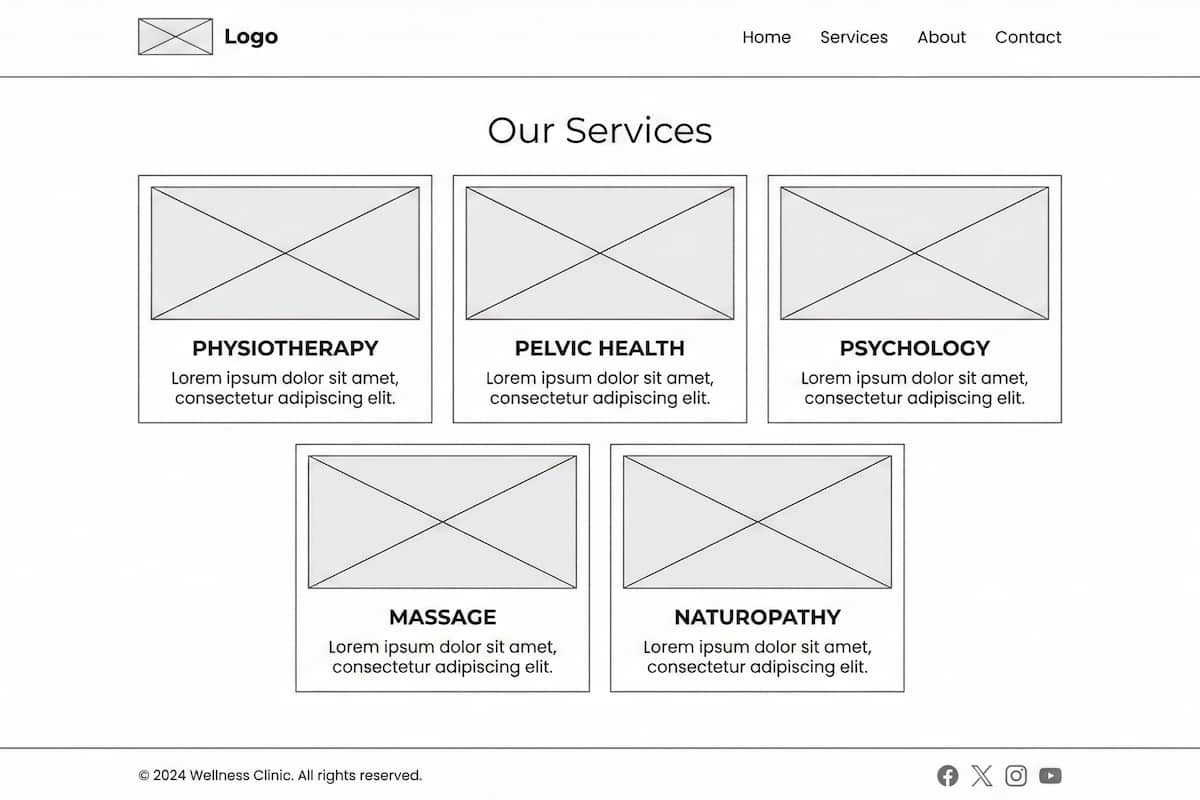
Step 2: Build Proper Service Pages (not just one generic Services page)
One of the strongest local SEO improvements you can make is creating separate service pages.
Examples for healthcare and wellness:
- Physiotherapy (general)
- Pelvic Health Physiotherapy
- Pregnancy and Postpartum Care
- Concussion Rehabilitation
- Clinical Psychology
- Anxiety Counselling
- ADHD Assessments
- Remedial Massage
- Naturopathic Consultations
Keep it practical
- Do not create a page for every diagnosis if you treat hundreds.
- Start with your core service categories.
- Then create pages for your highest-value or most-loved focus areas.
A good rule from the transcript: do not make your site navigation overly deep. Keep your services list sensible and easy to use.
What a High-Performing Service Page Should Include
Your service pages should be built for two audiences:
- Google, to understand what you do and where you do it
- Humans, to feel safe enough to enquire or book
Include:
- 1Clear page title The exact service name.
- 2Real photos Prefer photos of your clinic, your team, and the patient experience. Stock photos are a weak substitute and can reduce trust.
- 3Detailed service description Short paragraphs, scannable, easy to read.
- 4Why you are different Use real language clients say, such as: “You’re the first person who actually listened to me.”
- 5Symptoms and diagnoses treated Include both:
- clinical terms
- everyday symptom language (what people actually type into Google)
- 1Pricing The transcript is direct on this: pricing should be visible. It supports autonomy and filters out poor-fit enquiries.
- 2Testimonials or proof Service-relevant proof is ideal.
- 3Service-specific FAQs This is one of the most valuable sections for both SEO and conversions. Use AI to generate question ideas if you want, but write the answers yourself.
- 4Clear call to action Book now, request an appointment, call, or enquiry form.
- 5Optional: embedded map If appropriate for your layout.
Step 3: Fix Your Contact Page for Conversions and Local SEO
Your contact page should make it easy to “do the thing”, which means completing the next step without confusion.
Your contact page should include:
- clear instructions on what happens next
- phone and email (click-to-call and click-to-email)
- a short enquiry form (not a full intake)
- address exactly as listed on your Google Business Profile
- booking link if you use discovery calls or online bookings
- optional: map embed, parking guidance, entry instructions
- optional: basic FAQs (parking, payment, appointment flow)
Once your contact flow is clear, the next step is making sure your wider funnel supports it, from awareness through to conversion. The Wonder Co explains this well in their wellness brand funnel guide.
Add a “what happens after” note
Example: “After you submit the form, our team will contact you within 1 business day.”
That removes uncertainty and improves follow-through.
Step 4: Optimise Your Google Business Profile (GBP)
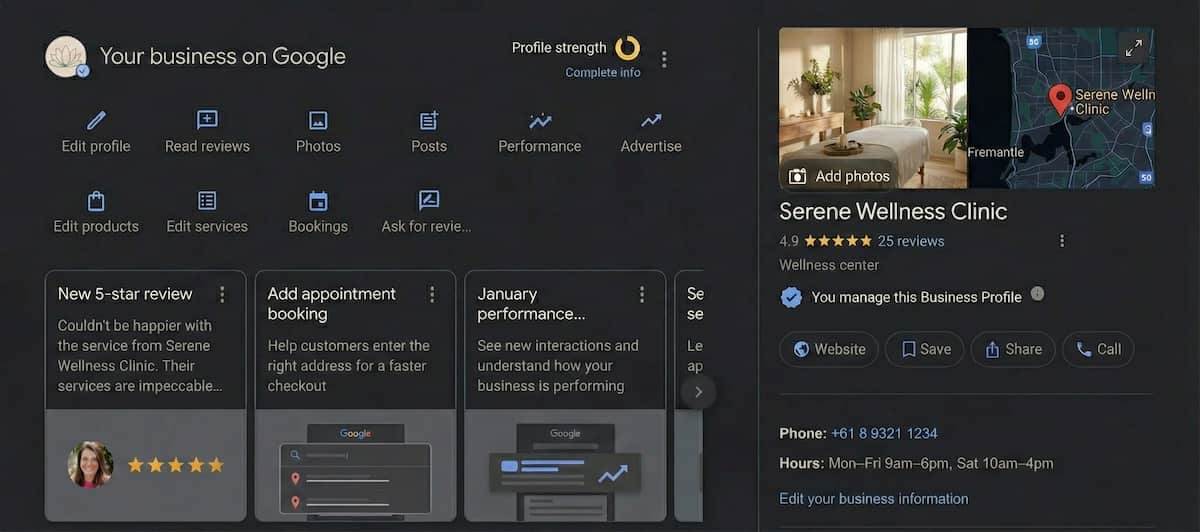
Your Google Business Profile is a major local SEO lever, especially when paired with your website.
Key actions:
- complete every field you can
- add services and relevant categories
- keep hours and info up to date
- post updates regularly (events, new services, new blog posts)
- get reviews where allowed, and respond to them
Important: NAP Consistency
NAP means Name, Address, Phone number.
Your NAP must match exactly across platforms, including:
- Google Maps
- Apple Maps
- Yelp
Same formatting, same spelling, same phone number.
This consistency is a trust signal to Google.
What if your industry cannot collect Google Reviews?
Some regions and industries have restrictions. If you cannot request or display Google reviews, there is no magic workaround.
Your approach is:
- over-invest in everything else
- strengthen website content and service pages
- tighten NAP consistency and directory presence
- build prominence through local features, collaborations, and content
Step 5: Increase “Prominence” With Local Signals
Prominence is influenced by the broader footprint of your business online.
Strong local actions include:
- collaborating with other local businesses
- publishing a trusted resources page (provider network)
- listing local events you participate in
- being featured in local publications or community articles
- guest blogging on relevant local sites
- ensuring Apple Maps and Yelp listings are accurate
These reinforce legitimacy and can support ranking improvements.
Your Quick-Start Local SEO Checklist (do this first)
If you want the simplest implementation plan, start here:
- 1Define your ideal client using the exercise above
- 2Create or improve core service pages, one per major service
- 3Upgrade your contact page to make booking clear and easy
- 4Ensure NAP consistency across key platforms
- 5Optimise your Google Business Profile fully
- 6Post GBP updates regularly
- 7Build local prominence through partnerships and features
If you want local SEO to drive consistent enquiries, focus on the fundamentals first. Get crystal clear on who you want to attract, build dedicated service pages that match what people actually search, and make it effortless to contact or book with you. Then tighten up your Google Business Profile and keep your business details consistent everywhere online. When those basics are in place, local SEO becomes a compounding asset that keeps bringing in high-intent clients month after month.

Two Ways To Win From This
Stay Visible In AI Search, Or Just Take The Leads
Do the work yourself and be the business the AI tools quote when somebody asks for your trade in your city. That is what everything above is for.
Or skip the build entirely and take the enquiries we already generate, exclusive to you, no shared leads and no bidding wars.
Either way, the fastest start is a conversation. Ring me and we will work out which one suits you.