
Is SEO worth it for tradies? It can be, at $500k, $1m or $10m a year. Your trade, your area, your margins and who does the work decide it far more than your turnover does.
I'm Levi Saunders, co-founder of The Lead Gen Lab. I've spent nearly 13 years in digital marketing, including plenty of mistakes, plenty of websites and a lot of time watching what actually makes the phone ring.
I'm Not Particularly Chasing Your SEO Campaign
Shock, horror: I don't particularly want your SEO campaign.

That doesn't mean I'll knock back the right business owner. If I sign on, I put my heart and soul into the campaign and do a great job. But SEO retainers aren't the main thing I'm chasing. I enjoy lead generation. I enjoy building and driving our own websites, proving they work, and then partnering with good operators.
Put it this way: why would I automatically want to build your website when I can build my own, generate the leads myself and create a commercial relationship from there?
I'm telling you that up front because I'm not trying to scare you into an SEO contract. I'm just giving you the view I've built over my years in digital marketing.
My answer to nearly every SEO question starts with the same annoying phrase: how long is a piece of string? Your trade, margins, location, competition, goals, capacity, website, reputation and the person doing the work all matter. But there are still some principles I think every tradie should understand.
What I Mean By SEO Now
SEO, search engine optimisation, is broader than putting some keywords on a website and ranking it in Google. For a local trade business, I think about the website, your Google Business Profile, which is the listing that shows your business on Google Maps, reviews, reputation, how fast and well the site works, useful content, evidence of past jobs, how often you're mentioned around the web and, more and more, whether AI search tools can understand your business and recommend it.
People now talk about GEO, short for generative engine optimisation, alongside SEO. It means helping AI tools like ChatGPT understand your business and mention it in their answers. I don't see that as a reason to throw SEO in the bin. I see it as an expansion of the same job: make the business easy to understand, credible, easy for search tools to read and genuinely useful wherever customers are searching. We've written more on GEO vs SEO if you want the detail.
Google's own guidance backs up the fundamentals. It says local results are mainly based on relevance, distance and prominence, which Google describes as how well known a business is, and that more reviews and positive ratings can help a business rank locally. Its search systems also aim to reward helpful, reliable, people-first content that shows first-hand expertise.
Is SEO Worth It At $500k, $1m Or $10m?
Yes, it can be worth it at any of those levels. But turnover alone is a terrible way to decide whether SEO makes sense.
These questions matter far more than a magic turnover number:
- What is the niche? Plumbing is very different from a narrow service inside plumbing.
- What city are you in, and how competitive is it?
- What are your margins?
- What work do you actually want more of?
- How much are your competitors spending?
- Who is doing the SEO?
What getting it wrong costs changes with size:
- At $500k, it hurts because the marketing budget is precious.
- At $1m, it can stall the next stage of growth.
- At $10m, a poor strategy can waste serious money.
The lesson I'd take from that: whatever size you are, don't do bad SEO.
Even if you can't afford a full campaign yet, you can still work on the basics: your Google Business Profile, reviews, service information, website quality, photos, past jobs and useful content. There's no financial excuse for ignoring how you show up in Google anymore.
Do You Need To Be A $10m Business First?
No. I've seen this idea pushed in paid ads, and I think it's one of the biggest fallacies going around.
A business turning over half a million dollars can absolutely work on SEO. It may not be able to throw huge money at it, but the owner can still get more reviews, document jobs, keep the website accurate, improve the Google Business Profile and learn the fundamentals.
Of course more budget helps. But the idea that you need to be a $10m business before SEO matters makes very little sense to me. Be especially careful when that message comes from someone whose answer is conveniently to sell you paid advertising forever.
How Much Should A Tradie Spend On SEO?
These are my rules of thumb, not universal industry prices:
| Turnover | My rough SEO view | Important qualification |
|---|---|---|
| Around $500k a year | About $1,500 + GST a month as a practical lower end if you are paying someone. | Margins, niche, location and competition can completely change the answer. |
| Around $1m a year | A couple of thousand dollars a month on good SEO is reasonable in many cases. | A plant hire business and a ceiling repair business can have completely different overheads and economics. |
| Around $10m a year | For a difficult national market, $10,000 a month is not automatically unreasonable. | Something like insurance can need far more work, against far more competition, than a narrow local trade. |
That's SEO budget, not the whole marketing budget. There's also a ceiling in any local market: only so many people in a given area are looking for a service at a given time.
The number I keep coming back to now is roughly $2,000 plus GST a month for a properly resourced campaign. I get very sceptical when someone promises a serious ongoing SEO campaign for $500 a month. At that price, where are the hours, the experienced people, the technical work, the content, the research, the work to get you mentioned on other sites, and the motivation to keep going supposed to come from?
What You Are Actually Paying For Each Month
You're paying to be seen by more of the right people and, in the end, to get more traffic and enquiries that turn into work. What happens underneath that depends on the campaign.
A good campaign may include:
- Technical fixes, so Google can read and load the site properly
- How the site's pages are organised, and improving the pages themselves
- Writing content for the site
- Local SEO, which means showing up when people nearby search for your trade, including work on your Google Business Profile
- A plan for getting more reviews
- Changes that turn more visitors into enquiries
- Links between your own pages, and mentions and listings on other sites
- Write-ups of past jobs
- Monitoring, analysis and changing the plan as the market moves
Blogging can still have a place, and yes, I see the irony of writing that in a blog. But I'm more and more interested in proof of business and proof of work. Show what you actually do. Show the jobs. Show the result. Show the customer experience. Build a website that works well on a phone and makes it obvious why someone should trust you.
The person managing this also needs enough experience to know what not to do. That costs money. The fee has to give the marketer enough resources and enough reason to keep doing the job properly, rather than signing you up, handing the account to a junior and moving on.
How Long Until SEO Brings Phone Calls?
There's no honest universal answer. Some campaigns never get off the ground. Others move surprisingly quickly.
I used to be comfortable with a new website taking a month or two before it produced a lead. With the systems we use now, we regularly see things move much faster, sometimes leads within weeks and occasionally within days. That's my experience with our own system for building and ranking new websites, not a guarantee that every new website should do the same.
By around two months, I want to see evidence that something is moving: Google indexing the pages, which means adding them to its search results, more visibility, relevant traffic, enquiries or other early signs. If nothing is changing, ask two questions. First, is the SEO provider actually good? Second, are you as the business owner giving them the material they need?
The best results I get are with owners who communicate. Your marketer can't magically know every job, every reason customers hold back, every technical detail and every advantage living in your head. I want regular access to that knowledge. My best clients speak to me at least weekly while we're building momentum.
By six months, a campaign done well can be producing strong lead flow in the right market. Again, the niche, the competition, the starting point and the work all matter.
Tried SEO Before And It Didn't Work?
One bad agency only proves that one campaign didn't work.
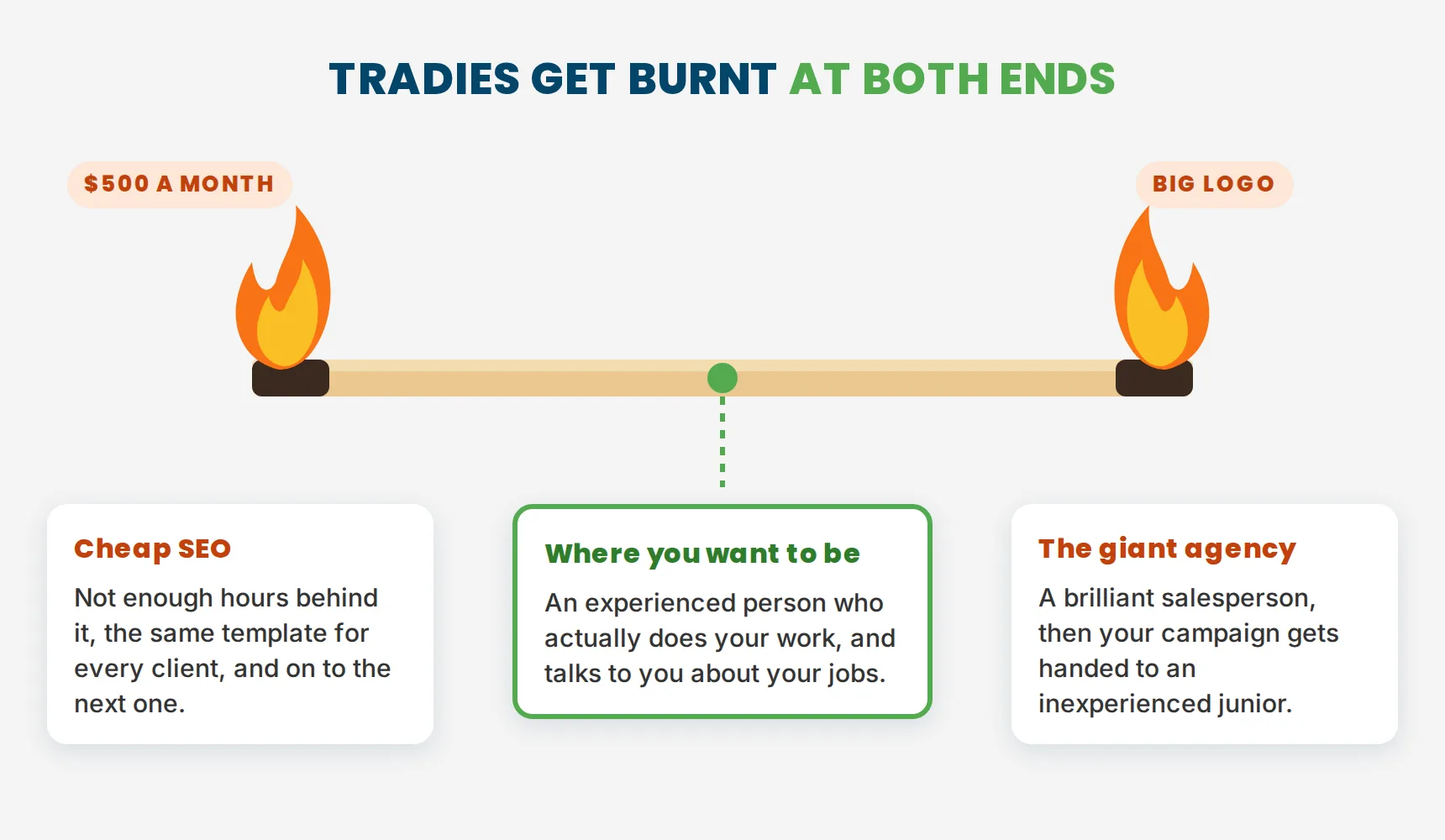
Tradies get burnt at both ends. Cheap SEO often doesn't have enough hours behind it, uses the same template for every client and is churn-and-burn: they sign you up and move on to the next one. But a giant agency with a brilliant reputation can also disappoint you if the salesperson is excellent and your campaign ends up with an inexperienced junior.
Inexperience matters because small technical mistakes can hang around for years:
- A badly handled move to a new website
- Old page addresses that no longer send people on to the new pages
- Copied or near-empty pages
- A muddled site structure and weak links between pages
- Slow hosting
- A website that was never built to turn visitors into enquiries in the first place
If you're choosing an agency, don't just research the logo on the proposal. Ask who will actually work on your campaign, how experienced that person is, what they'll need from you and what happens if the plan isn't working.
Is SEO Dead Now That AI Answers The Question?
No. Search is changing, not disappearing.
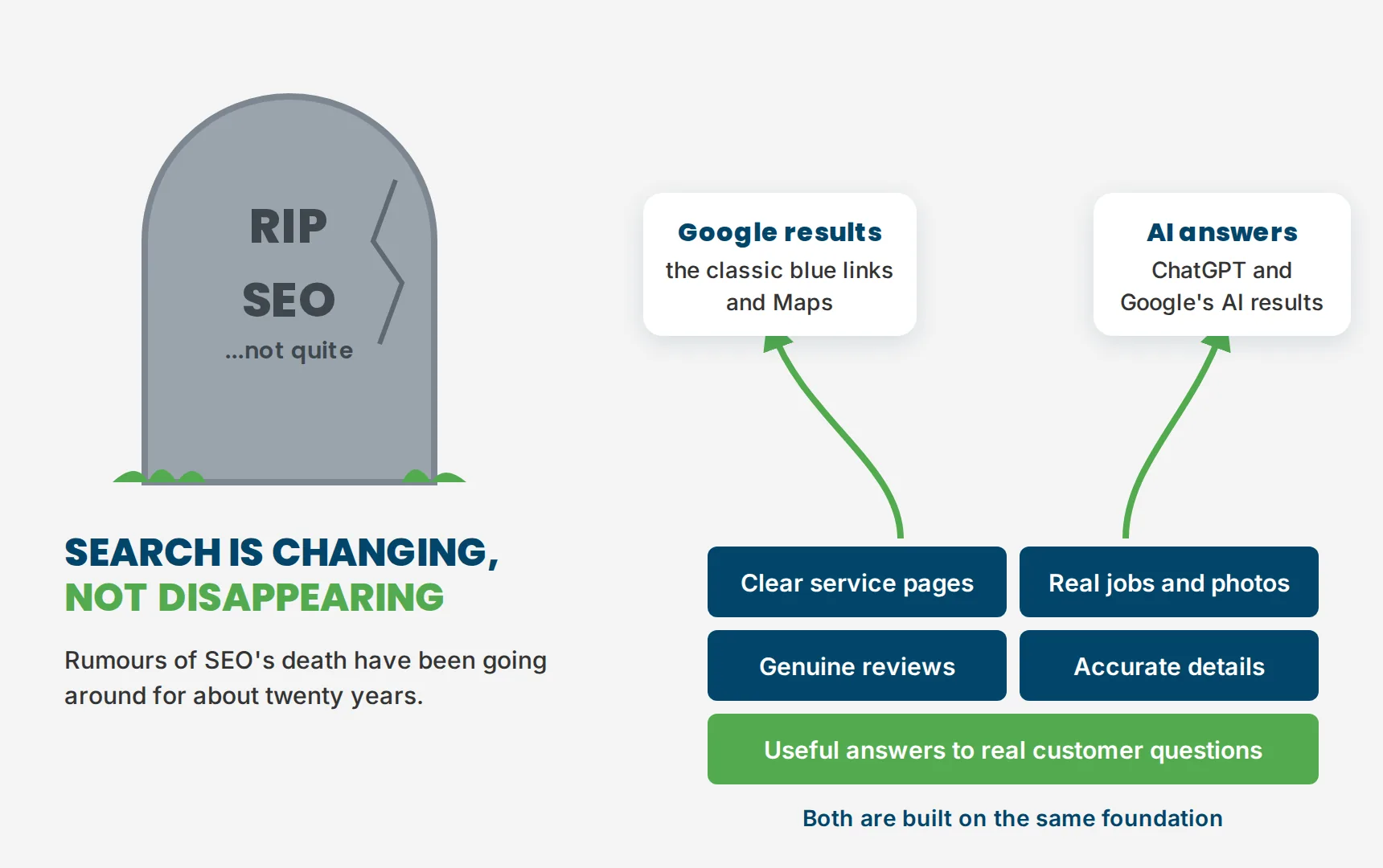
Google now has AI features inside Search. Customers also ask questions in tools like ChatGPT. That means businesses need to think beyond a single ranking in a list of blue links, but the underlying job still looks familiar: be easy for search tools to read, be clear about what you do, be useful and trusted, and back it up with real-world evidence.
I wouldn't build a strategy around trying to trick an AI tool. I'd build the strongest online presence I can: expert service information, genuine jobs, reviews, accurate business details, a strong reputation and useful answers to the questions customers actually ask.
SEO Or Google Ads First?
SEO can absolutely reduce your reliance on ads, sometimes to the point where you can turn the ads off for a while or for good. But that depends on how many leads you need and how many people are searching for your service in your area.
Paid advertising is still useful. It:
- Gives you exposure straight away
- Lets you push specific services
- Builds awareness of your name
- Gives you another lever when you need more work
I like the flexibility of having both.
The difference is that a strong organic presence, meaning you show up in Google's unpaid results, keeps working while you're not paying for every click. Ads are a tap you can turn up and down. SEO is an asset you keep building. I don't think a business owner should feel chained to paid advertising forever.
Is A Google Business Profile Enough?
A Google Business Profile, the listing that shows your business on Google Maps and in local results, is massively important for a local business. But I wouldn't treat it as a replacement for the rest of your online presence.
Google says local ranking is mainly based on relevance, distance and prominence, and it pulls business information from several sources, including the business's own website, what users add and other public information. That's exactly why I want the profile and the website supporting each other, rather than pretending one makes the other unnecessary.
Keep the profile complete and accurate. Get genuine reviews. Respond to them. Add useful photos. Our guide to Google Business Profile optimisation goes through it step by step. But also make sure the website proves the business behind the listing is real, capable and relevant.
Word Of Mouth And Hipages: Do I Still Need A Website That Ranks?
If those channels are filling the diary today, great. I still wouldn't want my whole business depending on them.
A website gives you something you own, and somewhere for a referral to check you out. A customer may hear your name from a mate and still Google you before calling. Your website, reviews and past jobs back up the recommendation.
It also gives you another line in the water. You can be booked out today and still invest in the things that build over time: reviews, job photos, past-job write-ups, useful content and reputation. You don't need to keep paid ads running when you can't take more work, but I'd keep improving the website and your listing. I've written more on that in Is Hipages worth it?
Can I Do My Own SEO, Or Just Use ChatGPT?
By all means use AI tools. They can help you learn, plan, organise ideas, analyse information and turn the knowledge in your head into useful content.
But be careful with the idea that access to an AI tool suddenly makes you an SEO expert. It's the modern version of someone discovering WordPress and deciding they can now build a website that brings in work. The result may look better than it did ten years ago, but you can still miss the strategy and the technical detail.
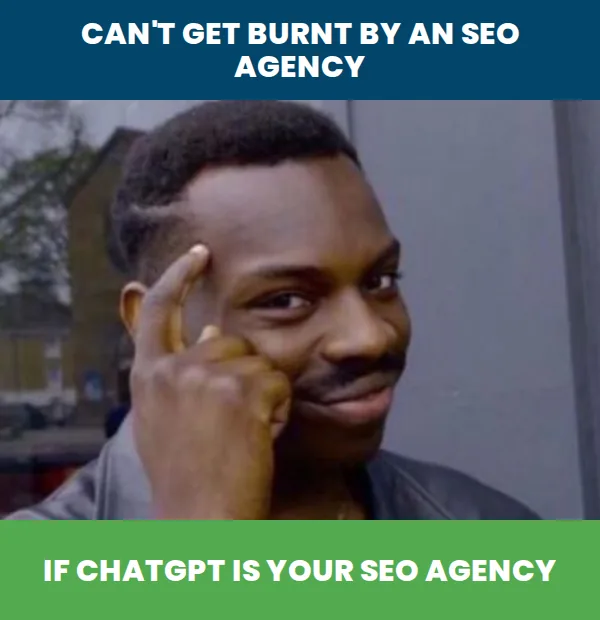
The best use of AI for a business owner is to make yourself more capable and more involved, not to assume the tool has removed the need for expertise.
The 80/20 Of SEO For A Tradie
If you strip away all the jargon, I'd focus on the things that prove you're a real, good business doing real, good work:
- Get the website working properly and easy to use on a phone.
- Make your core services and service areas clear.
- Keep your Google Business Profile accurate.
- Ask happy customers for genuine reviews.
- Photograph your work.
- Turn strong jobs into detailed past-job pages: what you did, where you did it, what problem you solved and why your approach mattered.
That material is gold because it comes from the business itself. Google talks openly about first-hand expertise and people-first content. You can't manufacture 10 years of actual trade experience with a prompt.
What Is GEO, And Does A Tradie Need It Yet?
GEO, generative engine optimisation, means improving the chance that AI tools can understand your business and mention it in the answers they write, in ChatGPT or in Google's AI results.
Yes, I think tradies should think about it. But I don't think they should panic and throw out everything they know about SEO.
The practical work overlaps heavily: clear, consistent business details, pages search tools can read easily, genuine expertise, useful answers, a strong reputation, reviews, listings on other sites and proof of work. For me, GEO is an extra lens over modern SEO, not permission to forget the fundamentals.
How To Show Up When Someone Asks ChatGPT For A Tradie
Start by becoming the easiest business in your market to check and understand.
Your website should clearly explain who you are, where you work, what you specialise in and why you're qualified to talk about it. Then:
- 1Build strong service pages, but also show actual jobs and customer outcomes.
- 2Keep your business details the same everywhere.
- 3Earn genuine reviews.
- 4Get mentioned and listed on legitimate sites.
- 5Answer the specific questions customers ask, rather than pumping out generic AI blogs.
This is also where longer, more specific searches get interesting. A customer may not just search "painter Perth". They may ask for a painter experienced with heritage homes, a particular finish, a particular suburb or a particular problem. The more clearly your website, reviews and listings show that expertise, the better placed you are to come up for that kind of question.
Is GEO Replacing SEO?
No. I see GEO as built on the same work as SEO.
Search engines and AI products are different systems, so nobody should pretend one checklist guarantees you'll show up everywhere. But a strong business doesn't suddenly become irrelevant because the screen looks different.
Build the best evidence of expertise, reputation and real work you can. Make it easy to find and read. Keep improving it. Then adjust the technical side as search changes.
What I Would Expect In The First 90 Days
The exact work depends on the site, but here's what I'd expect a campaign to get done in the first 90 days, roughly in this order.
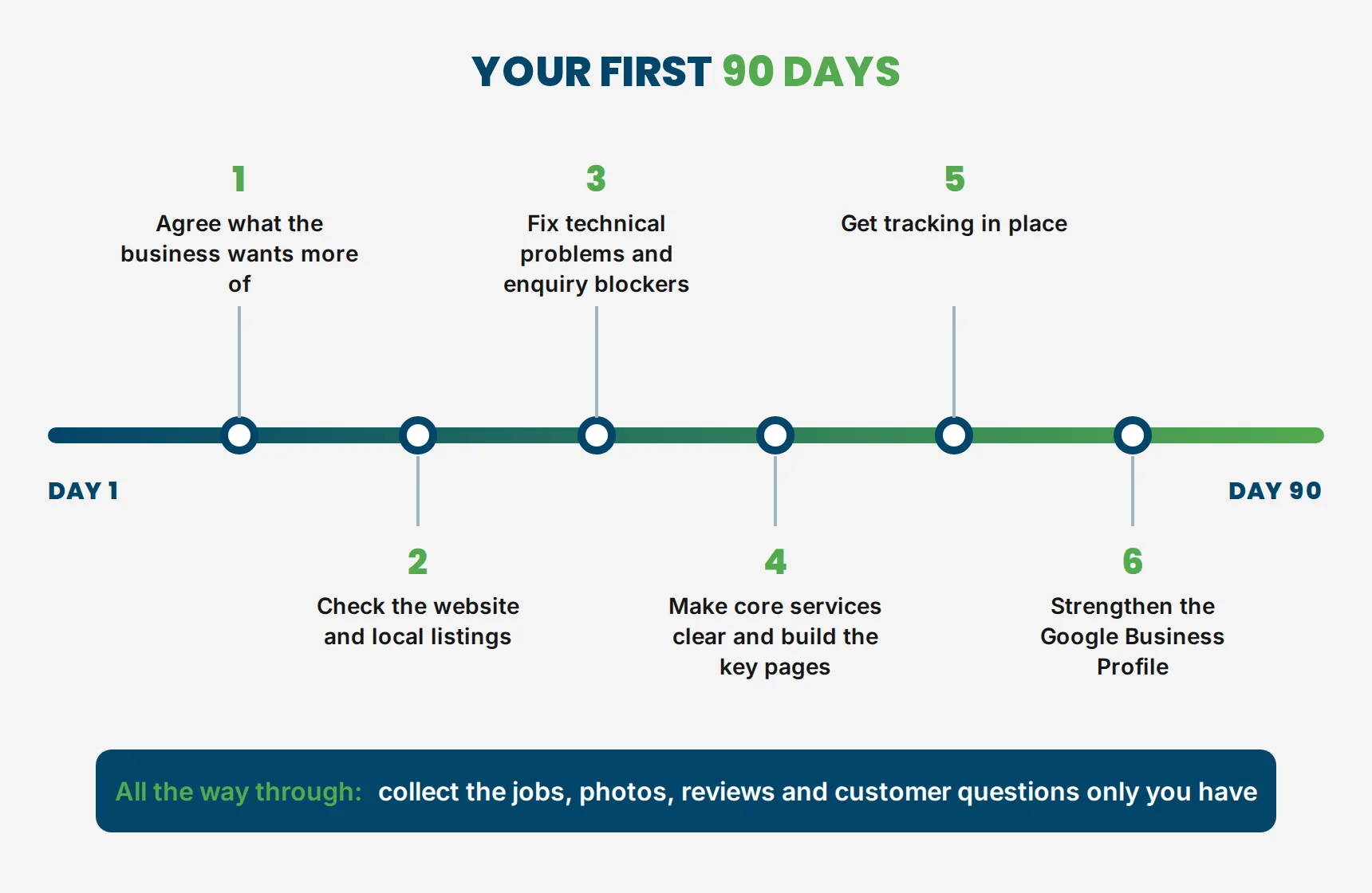
That means real job information, customer questions, photos, reviews, service details and the things the business owner knows that competitors can't simply copy. I don't want three months of "SEO activity" with no connection to leads, customers or the actual business.
The Part Business Owners Need To Own
Your SEO provider can't manufacture your reputation for you. They can build systems, make it easier to ask for reviews and turn raw information into content, but you did the job. You have the relationship with the customer. Ask for the review.
The same goes for expertise. Give your marketer access to it. Talk to them. Send the photos. Explain the difficult jobs. Tell them why one product fails and another works. Tell them what customers misunderstand. That's the material that separates a real trade business from another generic website.

My Bottom Line
SEO isn't something only $10m businesses are allowed to think about. It's also not something you should throw money at because an agency salesperson told you it's "essential".
At any size, build your organic presence. At smaller sizes, do the basics relentlessly. When you can afford professional help, research the person doing the work as hard as you research the agency. And when you find someone good, give them the information and access they need to do the job.
I'm biased toward SEO because I've spent years getting good at it. But I'm not particularly chasing your SEO retainer. I like lead generation and I like building our own assets. If the right business owner wants me involved in their SEO, I'm open to it. I just don't need to tell you SEO is magic to win the work.
That's probably why my advice is simple: own as much of your visibility as you can, keep proving your business is real and good at what it does, and never stop improving your website and listings just because the diary happens to be full this month.
Questions Tradies Ask About SEO
Potentially either. If Google search and Maps are already bringing you enough of the local demand, you may be able to cut back or pause ads. If you want faster growth, want to push a new service hard or want to cover more areas, you may still want both. The point is flexibility: I don't want a business stuck depending on one paid channel.
Absolutely, but investing doesn't always mean buying more leads. Keep asking for reviews. Record your jobs. Photograph the work. Keep the website accurate. Improve your past-job write-ups. Keep building while the diary is full, so you're not starting from zero when the market changes.
First ask what "can't handle" actually means. Is the bottleneck quoting, answering the phone, labour, scheduling or job capacity? Strong demand may let you put your prices up, be more selective, build a waiting list, hire, or refer work to people you trust. Whatever you do, get back to the leads. Your reputation is still on the line even when you can't take the job.
Then aim your SEO at the work you actually want. Better work partly comes down to who you aim your marketing at and how you present the business. Build pages and proof around the higher-value services, problems, properties and customers you want. The goal is the right traffic: people who see the website and think, this is the business I want.
They're evidence. They show customers, and give search tools more information about, what you actually do, where you do it and whether people are happy with the result. A strong past-job page holds genuine first-hand detail that generic content can't fake.
In the end: more of the right enquiries and customers. Before that, you can watch whether Google is indexing your pages, your rankings, how often you're seen, relevant traffic and how many visitors enquire. Traffic alone isn't the prize. If it isn't turning into real opportunities, the campaign needs work.
A strong site shouldn't disappear the day you stop paying someone. But competitors keep moving, search changes and content goes stale. How fast you slip depends on the market. A narrow local niche may hold for years, while a competitive national campaign can lose ground much faster. Good SEO should leave you with an asset and a base to build from.
If it were my business, with what I know now, I'd lean heavily toward SEO, because that's what I know and trust. If I were a business owner without that knowledge, I'd look carefully at the market and the provider, and I might test other channels, including paid social media, before committing. There's no universal answer.
Responsibility. You can outsource specialist SEO work, but don't outsource your understanding of your own business. Your marketer needs your knowledge, jobs, photos, the words your customers use and your expertise. And you still need to know who is actually managing the campaign, rather than assuming the agency's logo guarantees the result.
I'd ask what the business is and where it works. Then the next questions follow: how competitive is the market, what work do you want, what are the margins, what are the plans for growth, what budget and capacity do you have, and do you want SEO, lead generation or both? "Here's my business, market it" is too open-ended. The plan has to start with what makes the business money. If you want to start that conversation, our free lead plan is the place.
Two Ways To Win From This
Stay Visible In AI Search, Or Just Take The Leads
Do the work yourself and be the business the AI tools quote when somebody asks for your trade in your city. That is what everything above is for.
Or skip the build entirely and take the enquiries we already generate, exclusive to you, no shared leads and no bidding wars.
Either way, the fastest start is a conversation. Ring me and we will work out which one suits you.